<?xml version="1.0"?>
<!DOCTYPE html    PUBLIC "-//W3C//DTD XHTML 1.1 plus MathML 2.0//EN"
           "http://www.w3.org/Math/DTD/mathml2/xhtml-math11-f.dtd">
<html xmlns="http://www.w3.org/1999/xhtml">
<head>
<meta name="GENERATOR" content="TtM 3.70" />
 <style type="text/css">
 div.p { margin-top: 7pt; }
 span.roman {font-family: serif; font-style: normal; font-weight: normal;} 
</style>


<title> Lab 6: estimation </title>
</head>
<body>
 
<h1 align="center">Lab 6: estimation </h1>

<h3 align="center">Ben Bolker </h3>

 &#169; 2005 Ben Bolker

<div class="p"><!----></div>
 <h2><a name="tth_sEc1">
1</a>&nbsp;&nbsp;Made-up data: negative binomial</h2>

<div class="p"><!----></div>
The simplest thing to do to convince yourself that
your attempts to estimate parameters are working
is to simulate the "data" yourself and see if
you get close to the right answers back.

<div class="p"><!----></div>
Start by making up some negative binomial "data":
first, set the random-number seed so we get
consistent results across different  R&nbsp;sessions:

<div class="p"><!----></div>
  <font color="#FF0000">
<pre>
&#62;&nbsp;set.seed(1001)
&nbsp;
</pre> </font>

<div class="p"><!----></div>
Generate 50 values with 
<math xmlns="http://www.w3.org/1998/Math/MathML">
<mrow><mi>&mu;</mi><mo>=</mo><mn>1</mn></mrow></math>, 
<math xmlns="http://www.w3.org/1998/Math/MathML">
<mrow><mi>k</mi><mo>=</mo><mn>0</mn><mo>.</mo><mn>4</mn></mrow></math>
(save the values in variables in case we
want to use them again later, or change
the parameters and run the code again):

<div class="p"><!----></div>
  <font color="#FF0000">
<pre>
&#62;&nbsp;mu.true&nbsp;=&nbsp;1
&#62;&nbsp;k.true&nbsp;=&nbsp;0.4
&#62;&nbsp;x&nbsp;=&nbsp;rnbinom(50,&nbsp;mu&nbsp;=&nbsp;mu.true,&nbsp;size&nbsp;=&nbsp;k.true)
&nbsp;
</pre> </font>

<div class="p"><!----></div>
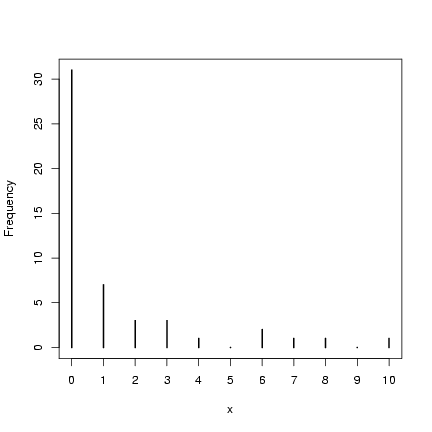
Take a quick look at what we got:

<div class="p"><!----></div>
  <font color="#FF0000">
<pre>
&#62;&nbsp;plot(table(factor(x,&nbsp;levels&nbsp;=&nbsp;0:max(x))),&nbsp;ylab&nbsp;=&nbsp;"Frequency",&nbsp;
+&nbsp;&nbsp;&nbsp;&nbsp;&nbsp;xlab&nbsp;=&nbsp;"x")
&nbsp;
</pre> </font>

<div class="p"><!----></div>
<img src="lab6-003.png" alt="lab6-003.png" />
(reminder: I won't always draw the pictures, but it's
good to make a habitat of examining your variables
(with <tt>summary()</tt> etc. and graphically) as you
go along to make sure you know what's going on!)

<div class="p"><!----></div>
Negative log-likelihood function for a simple
draw from a negative binomial distribution:
the first parameter, <tt>p</tt>, will be the
vector of parameters, and the second parameter,
<tt>dat</tt>, will be the data vector (in case we
want to try this again later with a different
set of data; by default we'll set it to the
<tt>x</tt> vector we just drew randomly).

<div class="p"><!----></div>
  <font color="#FF0000">
<pre>
&#62;&nbsp;NLLfun1&nbsp;=&nbsp;function(p,&nbsp;dat&nbsp;=&nbsp;x)&nbsp;{
+&nbsp;&nbsp;&nbsp;&nbsp;&nbsp;mu&nbsp;=&nbsp;p[1]
+&nbsp;&nbsp;&nbsp;&nbsp;&nbsp;k&nbsp;=&nbsp;p[2]
+&nbsp;&nbsp;&nbsp;&nbsp;&nbsp;-sum(dnbinom(x,&nbsp;mu&nbsp;=&nbsp;mu,&nbsp;size&nbsp;=&nbsp;k,&nbsp;log&nbsp;=&nbsp;TRUE))
+&nbsp;}
&nbsp;
</pre> </font>

<div class="p"><!----></div>
Calculate the negative log-likelihood for the true values.
I have to combine these values into a vector with
<tt>c()</tt> to pass them to the negative
log-likelihood function.
Naming the elements in the vector is optional
but will help keep things clear as we go along:

<div class="p"><!----></div>
  <font color="#FF0000">
<pre>
&#62;&nbsp;nll.true&nbsp;=&nbsp;NLLfun1(c(mu&nbsp;=&nbsp;mu.true,&nbsp;k&nbsp;=&nbsp;k.true))
&#62;&nbsp;nll.true
&nbsp;
</pre> </font>
  <font color="#0000FF">
<pre>
[1]&nbsp;72.64764

&nbsp;
</pre> </font>

<div class="p"><!----></div>
The NLL for other parameter values that I know are
way off (
<math xmlns="http://www.w3.org/1998/Math/MathML">
<mrow><mi>&mu;</mi><mo>=</mo><mn>10</mn></mrow></math>, 
<math xmlns="http://www.w3.org/1998/Math/MathML">
<mrow><mi>k</mi><mo>=</mo><mn>10</mn></mrow></math>):

<div class="p"><!----></div>
  <font color="#FF0000">
<pre>
&#62;&nbsp;NLLfun1(c(mu&nbsp;=&nbsp;10,&nbsp;k&nbsp;=&nbsp;10))
&nbsp;
</pre> </font>
  <font color="#0000FF">
<pre>
[1]&nbsp;291.4351

&nbsp;
</pre> </font>

<div class="p"><!----></div>
Much higher negative log-likelihood, as it should be.

<div class="p"><!----></div>
Find the method-of-moments estimates for 
<math xmlns="http://www.w3.org/1998/Math/MathML">
<mrow><mi>&mu;</mi></mrow></math> and 
<math xmlns="http://www.w3.org/1998/Math/MathML">
<mrow><mi>k</mi></mrow></math>:

<div class="p"><!----></div>
  <font color="#FF0000">
<pre>
&#62;&nbsp;m&nbsp;=&nbsp;mean(x)
&#62;&nbsp;v&nbsp;=&nbsp;var(x)
&#62;&nbsp;mu.mom&nbsp;=&nbsp;m
&#62;&nbsp;k.mom&nbsp;=&nbsp;m/(v/m&nbsp;-&nbsp;1)
&nbsp;
</pre> </font>

<div class="p"><!----></div>
Negative log-likelihood estimate for method of moments
parameters:

<div class="p"><!----></div>
  <font color="#FF0000">
<pre>
&#62;&nbsp;nll.mom&nbsp;=&nbsp;NLLfun1(c(mu&nbsp;=&nbsp;mu.mom,&nbsp;k&nbsp;=&nbsp;k.mom))
&#62;&nbsp;nll.mom
&nbsp;
</pre> </font>
  <font color="#0000FF">
<pre>
[1]&nbsp;72.08996

&nbsp;
</pre> </font>

<div class="p"><!----></div>
Despite the known bias, this estimate is better (lower 
negative log-likelihood) than the "true" parameter
values.  The Likelihood Ratio Test would say, however,
that the difference in likelihoods would have to 
be greater than 
<math xmlns="http://www.w3.org/1998/Math/MathML">
<mrow>
<msubsup><mrow><mi>&chi;</mi></mrow><mrow><mn>2</mn> </mrow>
<mrow><mn>2</mn></mrow></msubsup>
<mo stretchy="false">(</mo><mn>0</mn><mo>.</mo><mn>95</mn><mo stretchy="false">)</mo><mo stretchy="false">/</mo><mn>2</mn></mrow></math> (two degrees of
freedom because we are allowing both 
<math xmlns="http://www.w3.org/1998/Math/MathML">
<mrow><mi>&mu;</mi></mrow></math> and 
<math xmlns="http://www.w3.org/1998/Math/MathML">
<mrow><mi>k</mi></mrow></math>
to change):

<div class="p"><!----></div>
  <font color="#FF0000">
<pre>
&#62;&nbsp;ldiff&nbsp;=&nbsp;nll.true&nbsp;-&nbsp;nll.mom
&#62;&nbsp;ldiff
&nbsp;
</pre> </font>
  <font color="#0000FF">
<pre>
[1]&nbsp;0.5576733

&nbsp;
</pre> </font>
  <font color="#FF0000">
<pre>
&#62;&nbsp;qchisq(0.95,&nbsp;df&nbsp;=&nbsp;2)/2
&nbsp;
</pre> </font>
  <font color="#0000FF">
<pre>
[1]&nbsp;2.995732

&nbsp;
</pre> </font>

<div class="p"><!----></div>
So - better, but not significantly better at 
<math xmlns="http://www.w3.org/1998/Math/MathML">
<mrow><mi>p</mi><mo>=</mo><mn>0</mn><mo>.</mo><mn>05</mn></mrow></math>.
(<tt>pchisq(2*ldiff,df=2,lower.tail=FALSE)</tt> would tell us the 
exact 
<math xmlns="http://www.w3.org/1998/Math/MathML">
<mrow><mi>p</mi></mrow></math>-value if we wanted to know.)

<div class="p"><!----></div>
But what is the MLE?  Use <tt>optim</tt> with 
the default options (Nelder-Mead simplex method)
and the method-of-moments estimates as the starting
estimates (<tt>par</tt>):

<div class="p"><!----></div>
  <font color="#FF0000">
<pre>
&#62;&nbsp;O1&nbsp;=&nbsp;optim(fn&nbsp;=&nbsp;NLLfun1,&nbsp;par&nbsp;=&nbsp;c(mu&nbsp;=&nbsp;mu.mom,&nbsp;k&nbsp;=&nbsp;k.mom),&nbsp;hessian&nbsp;=&nbsp;TRUE)
&#62;&nbsp;O1
&nbsp;
</pre> </font>
  <font color="#0000FF">
<pre>
$par
&nbsp;&nbsp;&nbsp;&nbsp;&nbsp;&nbsp;&nbsp;mu&nbsp;&nbsp;&nbsp;&nbsp;&nbsp;&nbsp;&nbsp;&nbsp;&nbsp;k&nbsp;
1.2602356&nbsp;0.2884793&nbsp;

$value
[1]&nbsp;71.79646

$counts
function&nbsp;gradient&nbsp;
&nbsp;&nbsp;&nbsp;&nbsp;&nbsp;&nbsp;45&nbsp;&nbsp;&nbsp;&nbsp;&nbsp;&nbsp;&nbsp;NA&nbsp;

$convergence
[1]&nbsp;0

$message
NULL

$hessian
&nbsp;&nbsp;&nbsp;&nbsp;&nbsp;&nbsp;&nbsp;&nbsp;&nbsp;&nbsp;&nbsp;&nbsp;mu&nbsp;&nbsp;&nbsp;&nbsp;&nbsp;&nbsp;&nbsp;&nbsp;&nbsp;&nbsp;&nbsp;&nbsp;k
mu&nbsp;7.387808331&nbsp;&nbsp;0.004901569
k&nbsp;&nbsp;0.004901569&nbsp;97.372581408


&nbsp;
</pre> </font>

<div class="p"><!----></div>
The optimization result is a list with 
elements:

<ul>
<li>the best-fit
parameters (<tt>O1$par</tt>, with parameter names because we named the
elements of the starting vector-see how useful this is?);
<div class="p"><!----></div>
</li>

<li>the minimum negative log-likelihood (<tt>O1$value</tt>);
<div class="p"><!----></div>
</li>

<li>information on the number of function evaluations
(<tt>O1$counts</tt>; the <tt>gradient</tt> part is <tt>NA</tt>
because we didn't specify a function to calculate
the derivatives (and the Nelder-Mead algorithm wouldn't
have used them anyway);
<div class="p"><!----></div>
</li>

<li>information on whether the
algorithm thinks it found a good answer
(<tt>O1$convergence</tt>, which is zero if  R&nbsp;thinks
everything worked and uses various numeric codes
(see <tt>?optim</tt> for details) if something goes
wrong;
<div class="p"><!----></div>
</li>

<li><tt>O1$message</tt> which may give further
information about the when the fit converged or
how it failed to converge;
<div class="p"><!----></div>
</li>

<li>because we set <tt>hessian=TRUE</tt>, we also
get <tt>O1$hessian</tt>, which gives the (finite difference
approximation of) the second derivatives evaluated
at the MLE
<div class="p"><!----></div>
</li>
</ul>

<div class="p"><!----></div>
The minimum negative log-likelihood
(71.8) is better than
either the negative log-likelihood 
corresponding to the method-of-moments
parameters (72.09) or
the true parameters (72.65),
but all of these are within the LRT cutoff.

<div class="p"><!----></div>
Now let's find the likelihood surface, the profiles,
and the confidence intervals.

<div class="p"><!----></div>
The likelihood surface is straightforward: set up
vectors of 
<math xmlns="http://www.w3.org/1998/Math/MathML">
<mrow><mi>&mu;</mi></mrow></math> and 
<math xmlns="http://www.w3.org/1998/Math/MathML">
<mrow><mi>k</mi></mrow></math> values and run <tt>for</tt>
loops, set up a matrix to hold the results, and run
<tt>for</tt> loops to calculate and store the values.
Let's try 
<math xmlns="http://www.w3.org/1998/Math/MathML">
<mrow><mi>&mu;</mi></mrow></math> from 0.4 to 3 in steps of 0.05 and

<math xmlns="http://www.w3.org/1998/Math/MathML">
<mrow><mi>k</mi></mrow></math> from 0.01 to 0.7 in steps of 0.01.
(I initially had the 
<math xmlns="http://www.w3.org/1998/Math/MathML">
<mrow><mi>&mu;</mi></mrow></math> vector from 0.1 to 2.0
but revised it after seeing the contour plot below.)

<div class="p"><!----></div>
  <font color="#FF0000">
<pre>
&#62;&nbsp;muvec&nbsp;=&nbsp;seq(0.4,&nbsp;3,&nbsp;by&nbsp;=&nbsp;0.05)
&#62;&nbsp;kvec&nbsp;=&nbsp;seq(0.01,&nbsp;0.7,&nbsp;by&nbsp;=&nbsp;0.01)
&nbsp;
</pre> </font>

<div class="p"><!----></div>
The matrix for the results will have
rows corresponding to 
<math xmlns="http://www.w3.org/1998/Math/MathML">
<mrow><mi>&mu;</mi></mrow></math> and
columns corresponding to 
<math xmlns="http://www.w3.org/1998/Math/MathML">
<mrow><mi>k</mi></mrow></math>:

<div class="p"><!----></div>
  <font color="#FF0000">
<pre>
&#62;&nbsp;resmat&nbsp;=&nbsp;matrix(nrow&nbsp;=&nbsp;length(muvec),&nbsp;ncol&nbsp;=&nbsp;length(kvec))
&nbsp;
</pre> </font>

<div class="p"><!----></div>
Run the <tt>for</tt> loops:

<div class="p"><!----></div>
  <font color="#FF0000">
<pre>
&#62;&nbsp;for&nbsp;(i&nbsp;in&nbsp;1:length(muvec))&nbsp;{
+&nbsp;&nbsp;&nbsp;&nbsp;&nbsp;for&nbsp;(j&nbsp;in&nbsp;1:length(kvec))&nbsp;{
+&nbsp;&nbsp;&nbsp;&nbsp;&nbsp;&nbsp;&nbsp;&nbsp;&nbsp;resmat[i,&nbsp;j]&nbsp;=&nbsp;NLLfun1(c(muvec[i],&nbsp;kvec[j]))
+&nbsp;&nbsp;&nbsp;&nbsp;&nbsp;}
+&nbsp;}
&nbsp;
</pre> </font>

<div class="p"><!----></div>
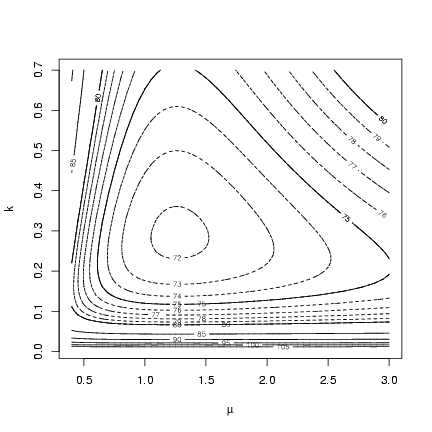
Drawing a contour: the initial default choice of contours
doesn't give us fine enough resolution (it picks contours
spaced 5 apart to cover the range of the values in the
matrix), so I added levels spaced 1 log-likelihood unit
apart from 70 to 80 by doing a second <tt>contour</tt>
plot with <tt>add=TRUE</tt>.

<div class="p"><!----></div>
  <font color="#FF0000">
<pre>
&#62;&nbsp;contour(muvec,&nbsp;kvec,&nbsp;resmat,&nbsp;xlab&nbsp;=&nbsp;expression(mu),&nbsp;ylab&nbsp;=&nbsp;"k")
&#62;&nbsp;contour(muvec,&nbsp;kvec,&nbsp;resmat,&nbsp;levels&nbsp;=&nbsp;70:80,&nbsp;lty&nbsp;=&nbsp;2,&nbsp;add&nbsp;=&nbsp;TRUE)
&nbsp;
</pre> </font>

<div class="p"><!----></div>
<img src="lab6-014.png" alt="lab6-014.png" />

<div class="p"><!----></div>
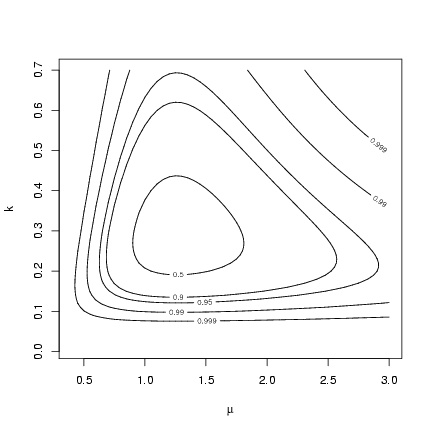
Alternately, we could set the levels of the contour
plot corresponding to different 
<math xmlns="http://www.w3.org/1998/Math/MathML">
<mrow><mn>1</mn><mo>-</mo><mi>&alpha;</mi></mrow></math> levels
for the likelihood ratio test: if the minimum
negative log-likelihood is 
<math xmlns="http://www.w3.org/1998/Math/MathML">
<mrow><mi>m</mi></mrow></math>, then these levels
are 
<math xmlns="http://www.w3.org/1998/Math/MathML">
<mrow><mi>m</mi><mo>+</mo>
<msubsup><mrow><mi>&chi;</mi></mrow><mrow><mn>2</mn> </mrow>
<mrow><mn>2</mn></mrow></msubsup>
<mo stretchy="false">(</mo><mi>&alpha;</mi><mo stretchy="false">)</mo><mo stretchy="false">/</mo><mn>2</mn></mrow></math>:

<div class="p"><!----></div>
  <font color="#FF0000">
<pre>
&#62;&nbsp;alevels&nbsp;=&nbsp;c(0.5,&nbsp;0.9,&nbsp;0.95,&nbsp;0.99,&nbsp;0.999)
&#62;&nbsp;minval&nbsp;=&nbsp;O1$value
&#62;&nbsp;nll.levels&nbsp;=&nbsp;qchisq(alevels,&nbsp;df&nbsp;=&nbsp;2)/2&nbsp;+&nbsp;minval
&#62;&nbsp;contour(muvec,&nbsp;kvec,&nbsp;resmat,&nbsp;levels&nbsp;=&nbsp;nll.levels,&nbsp;labels&nbsp;=&nbsp;alevels,&nbsp;
+&nbsp;&nbsp;&nbsp;&nbsp;&nbsp;xlab&nbsp;=&nbsp;expression(mu),&nbsp;ylab&nbsp;=&nbsp;"k")
&nbsp;
</pre> </font>

<div class="p"><!----></div>
<img src="lab6-015.png" alt="lab6-015.png" />

<div class="p"><!----></div>
So far, so good.  Finding the profiles and confidence limits
is a bit harder.

<div class="p"><!----></div>
To calculate the 
<math xmlns="http://www.w3.org/1998/Math/MathML">
<mrow><mi>&mu;</mi></mrow></math> profile, define a new function that
takes 
<math xmlns="http://www.w3.org/1998/Math/MathML">
<mrow><mi>&mu;</mi></mrow></math> as a <em>separate</em> parameter (which <tt>optim</tt>
will not try to adjust as it goes along) and optimizes with respect to 
<math xmlns="http://www.w3.org/1998/Math/MathML">
<mrow><mi>k</mi></mrow></math>:

<div class="p"><!----></div>
  <font color="#FF0000">
<pre>
&#62;&nbsp;NLLfun.mu&nbsp;=&nbsp;function(p,&nbsp;mu)&nbsp;{
+&nbsp;&nbsp;&nbsp;&nbsp;&nbsp;k&nbsp;=&nbsp;p[1]
+&nbsp;&nbsp;&nbsp;&nbsp;&nbsp;-sum(dnbinom(x,&nbsp;mu&nbsp;=&nbsp;mu,&nbsp;size&nbsp;=&nbsp;k,&nbsp;log&nbsp;=&nbsp;TRUE))
+&nbsp;}
&nbsp;
</pre> </font>

<div class="p"><!----></div>
Set up a matrix with two columns (one for the best-fit 
<math xmlns="http://www.w3.org/1998/Math/MathML">
<mrow><mi>k</mi></mrow></math> value,
one for the minimum negative log-likelihood achieved):

<div class="p"><!----></div>
  <font color="#FF0000">
<pre>
&#62;&nbsp;mu.profile&nbsp;=&nbsp;matrix(ncol&nbsp;=&nbsp;2,&nbsp;nrow&nbsp;=&nbsp;length(muvec))
&nbsp;
</pre> </font>

<div class="p"><!----></div>
Run a <tt>for</tt> loop, starting the optimization
from the maximum-likelihood value of 
<math xmlns="http://www.w3.org/1998/Math/MathML">
<mrow><mi>k</mi></mrow></math> every time.
Also include the value for 
<math xmlns="http://www.w3.org/1998/Math/MathML">
<mrow><mi>&mu;</mi></mrow></math> (<tt>mu=muvec[i]</tt>),
which  R&nbsp;will pass on to the function that computes
the negative log-likelihood.

<div class="p"><!----></div>
The default Nelder-Mead method doesn't work well on
1-dimensional problems, and will give a warning.
I tried <tt>method="BFGS"</tt> instead 
but got warnings about 
<tt>NaNs produced in ... </tt>,
because <tt>optim</tt>
tries some negative values for 
<math xmlns="http://www.w3.org/1998/Math/MathML">
<mrow><mi>k</mi></mrow></math>
on its way to the correct (positive) answer.
I then switched to <tt>L-BFGS-B</tt> and set
<tt>lower=0.002</tt>, far enough above zero that
<tt>optim</tt> wouldn't run into any negative
numbers when it calculated the derivatives
by finite differences.
Another option would have been to change the
function around so that it minimized with
respect to 
<math xmlns="http://www.w3.org/1998/Math/MathML">
<mrow><mi>log</mi><mo stretchy="false">(</mo><mi>k</mi><mo stretchy="false">)</mo></mrow></math> instead of 
<math xmlns="http://www.w3.org/1998/Math/MathML">
<mrow><mi>k</mi></mrow></math>. This function
would look something like:

<div class="p"><!----></div>
  <font color="#FF0000">
<pre>
&#62;&nbsp;NLLfun.mu2&nbsp;=&nbsp;function(p,&nbsp;mu)&nbsp;{
+&nbsp;&nbsp;&nbsp;&nbsp;&nbsp;logk&nbsp;=&nbsp;p[1]
+&nbsp;&nbsp;&nbsp;&nbsp;&nbsp;k&nbsp;=&nbsp;exp(logk)
+&nbsp;&nbsp;&nbsp;&nbsp;&nbsp;-sum(dnbinom(x,&nbsp;mu&nbsp;=&nbsp;mu,&nbsp;size&nbsp;=&nbsp;k,&nbsp;log&nbsp;=&nbsp;TRUE))
+&nbsp;}
&nbsp;
</pre> </font>

<div class="p"><!----></div>
and of course we would have to translate the
answers back from the log scale to compare them
to the results so far.
(The other option
would be to use <tt>optimize</tt>, a function specially
designed for 1D optimization, but this way we have
to do less rearranging of the code.)

<div class="p"><!----></div>
A general comment about warnings: it's OK to
ignore warnings <b>if you understand exactly
where they come from and have satisfied yourself
that whatever problem is causing the warnings
does not affect your answer in any significant
way</b>.  Ignoring warnings at any other time is
a good way to overlook bugs in your code or
serious problems with numerical methods that
will make your answers nonsensical.

<div class="p"><!----></div>
So, anyway - run that optimization for each
value of 
<math xmlns="http://www.w3.org/1998/Math/MathML">
<mrow><mi>&mu;</mi></mrow></math> in the 
<math xmlns="http://www.w3.org/1998/Math/MathML">
<mrow><mi>&mu;</mi></mrow></math> vector.
At each step, save the parameter estimate and
the minimum negative log-likelihood:

<div class="p"><!----></div>
  <font color="#FF0000">
<pre>
&#62;&nbsp;for&nbsp;(i&nbsp;in&nbsp;1:length(muvec))&nbsp;{
+&nbsp;&nbsp;&nbsp;&nbsp;&nbsp;Oval&nbsp;=&nbsp;optim(fn&nbsp;=&nbsp;NLLfun.mu,&nbsp;par&nbsp;=&nbsp;O1$par["k"],&nbsp;method&nbsp;=&nbsp;"L-BFGS-B",&nbsp;
+&nbsp;&nbsp;&nbsp;&nbsp;&nbsp;&nbsp;&nbsp;&nbsp;&nbsp;lower&nbsp;=&nbsp;0.002,&nbsp;mu&nbsp;=&nbsp;muvec[i])
+&nbsp;&nbsp;&nbsp;&nbsp;&nbsp;mu.profile[i,&nbsp;]&nbsp;=&nbsp;c(Oval$par,&nbsp;Oval$value)
+&nbsp;}
&#62;&nbsp;colnames(mu.profile)&nbsp;=&nbsp;c("k",&nbsp;"NLL")
&nbsp;
</pre> </font>

<div class="p"><!----></div>
Do the same process for 
<math xmlns="http://www.w3.org/1998/Math/MathML">
<mrow><mi>k</mi></mrow></math>:

<div class="p"><!----></div>
  <font color="#FF0000">
<pre>
&#62;&nbsp;NLLfun.k&nbsp;=&nbsp;function(p,&nbsp;k)&nbsp;{
+&nbsp;&nbsp;&nbsp;&nbsp;&nbsp;mu&nbsp;=&nbsp;p[1]
+&nbsp;&nbsp;&nbsp;&nbsp;&nbsp;-sum(dnbinom(x,&nbsp;mu&nbsp;=&nbsp;mu,&nbsp;size&nbsp;=&nbsp;k,&nbsp;log&nbsp;=&nbsp;TRUE))
+&nbsp;}
&#62;&nbsp;k.profile&nbsp;=&nbsp;matrix(ncol&nbsp;=&nbsp;2,&nbsp;nrow&nbsp;=&nbsp;length(kvec))
&#62;&nbsp;for&nbsp;(i&nbsp;in&nbsp;1:length(kvec))&nbsp;{
+&nbsp;&nbsp;&nbsp;&nbsp;&nbsp;Oval&nbsp;=&nbsp;optim(fn&nbsp;=&nbsp;NLLfun.k,&nbsp;par&nbsp;=&nbsp;O1$par["mu"],&nbsp;method&nbsp;=&nbsp;"L-BFGS-B",&nbsp;
+&nbsp;&nbsp;&nbsp;&nbsp;&nbsp;&nbsp;&nbsp;&nbsp;&nbsp;lower&nbsp;=&nbsp;0.002,&nbsp;k&nbsp;=&nbsp;kvec[i])
+&nbsp;&nbsp;&nbsp;&nbsp;&nbsp;k.profile[i,&nbsp;]&nbsp;=&nbsp;c(Oval$par,&nbsp;Oval$value)
+&nbsp;}
&#62;&nbsp;colnames(k.profile)&nbsp;=&nbsp;c("mu",&nbsp;"NLL")
&nbsp;
</pre> </font>

<div class="p"><!----></div>
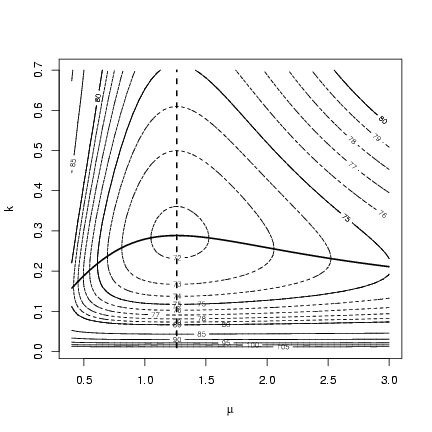
Redraw the contour plot with profiles added:

<div class="p"><!----></div>
  <font color="#FF0000">
<pre>
&#62;&nbsp;contour(muvec,&nbsp;kvec,&nbsp;resmat,&nbsp;xlab&nbsp;=&nbsp;expression(mu),&nbsp;ylab&nbsp;=&nbsp;"k")
&#62;&nbsp;contour(muvec,&nbsp;kvec,&nbsp;resmat,&nbsp;levels&nbsp;=&nbsp;70:80,&nbsp;lty&nbsp;=&nbsp;2,&nbsp;add&nbsp;=&nbsp;TRUE)
&#62;&nbsp;lines(muvec,&nbsp;mu.profile[,&nbsp;"k"],&nbsp;lwd&nbsp;=&nbsp;2)
&#62;&nbsp;lines(k.profile[,&nbsp;"mu"],&nbsp;kvec,&nbsp;lwd&nbsp;=&nbsp;2,&nbsp;lty&nbsp;=&nbsp;2)
&nbsp;
</pre> </font>

<div class="p"><!----></div>
<img src="lab6-021.png" alt="lab6-021.png" />

<div class="p"><!----></div>
The contour for 
<math xmlns="http://www.w3.org/1998/Math/MathML">
<mrow><mi>&mu;</mi></mrow></math> is completely independent of 
<math xmlns="http://www.w3.org/1998/Math/MathML">
<mrow><mi>k</mi></mrow></math>:
no matter what value you choose for 
<math xmlns="http://www.w3.org/1998/Math/MathML">
<mrow><mi>k</mi></mrow></math>, the best estimate
of 
<math xmlns="http://www.w3.org/1998/Math/MathML">
<mrow><mi>&mu;</mi></mrow></math> is still the same (and equal to the mean of the
observed data).  In contrast, values of 
<math xmlns="http://www.w3.org/1998/Math/MathML">
<mrow><mi>&mu;</mi></mrow></math> either
above or below the best value lead to estimates of 
<math xmlns="http://www.w3.org/1998/Math/MathML">
<mrow><mi>k</mi></mrow></math>
that are lower than the MLE.

<div class="p"><!----></div>
<b>Exercise  1</b>:
Redraw the contour plot of the likelihood surface
for this data set with the contours corresponding
to 
<math xmlns="http://www.w3.org/1998/Math/MathML">
<mrow><mi>&alpha;</mi></mrow></math> levels, as above.  Add points corresponding to the
location of the MLE, the method-of-moments estimate, and the true values.
State your conclusions about the differences among these
3 sets of parameters and their statistical significance.

<div class="p"><!----></div>
 <h2><a name="tth_sEc2">
2</a>&nbsp;&nbsp;Univariate profiles</h2>
Now we'd like to find the univariate confidence limits on 
<math xmlns="http://www.w3.org/1998/Math/MathML">
<mrow><mi>&mu;</mi></mrow></math> and 
<math xmlns="http://www.w3.org/1998/Math/MathML">
<mrow><mi>k</mi></mrow></math>.
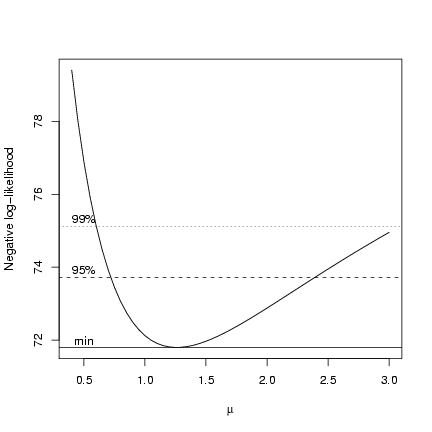
It's easy enough to get an approximate idea of this graphically.
For example, for 
<math xmlns="http://www.w3.org/1998/Math/MathML">
<mrow><mi>&mu;</mi></mrow></math>, plotting the profile and
superimposing horizontal lines for the minimum NLL and the 95% and 99%
LRT cutoffs:

<div class="p"><!----></div>
  <font color="#FF0000">
<pre>
&#62;&nbsp;plot(muvec,&nbsp;mu.profile[,&nbsp;"NLL"],&nbsp;type&nbsp;=&nbsp;"l",&nbsp;xlab&nbsp;=&nbsp;expression(mu),&nbsp;
+&nbsp;&nbsp;&nbsp;&nbsp;&nbsp;ylab&nbsp;=&nbsp;"Negative&nbsp;log-likelihood")
&#62;&nbsp;cutoffs&nbsp;=&nbsp;c(0,&nbsp;qchisq(c(0.95,&nbsp;0.99),&nbsp;1)/2)
&#62;&nbsp;nll.levels&nbsp;=&nbsp;O1$value&nbsp;+&nbsp;cutoffs
&#62;&nbsp;abline(h&nbsp;=&nbsp;nll.levels,&nbsp;lty&nbsp;=&nbsp;1:3)
&#62;&nbsp;text(rep(0.5,&nbsp;3),&nbsp;nll.levels&nbsp;+&nbsp;0.2,&nbsp;c("min",&nbsp;"95%",&nbsp;"99%"))
&nbsp;
</pre> </font>

<div class="p"><!----></div>
<img src="lab6-022.png" alt="lab6-022.png" />

<div class="p"><!----></div>
But how do we find the 
<math xmlns="http://www.w3.org/1998/Math/MathML">
<mrow><mi>x</mi></mrow></math>-intercepts (
<math xmlns="http://www.w3.org/1998/Math/MathML">
<mrow><mi>&mu;</mi></mrow></math> values) associated
with the points where the likelihood profile crosses the cutoff lines?

<div class="p"><!----></div>
Three possibilities:

<ol type="1">
<li>If we have sampled the profile at a fairly fine scale,
we can just look for the point(s) that are closest to
the cutoff value:

<div class="p"><!----></div>
  <font color="#FF0000">
<pre>
&#62;&nbsp;cutoff&nbsp;=&nbsp;O1$value&nbsp;+&nbsp;qchisq(0.95,&nbsp;1)/2
&nbsp;
</pre> </font>

<div class="p"><!----></div>
The <tt>which.min</tt> function gives the
index of the smallest element in the vector:
if we find the index corresponding to
the smallest value of the absolute
value of the profile negative log-likelihood
minus the cutoff, that should give us
the 
<math xmlns="http://www.w3.org/1998/Math/MathML">
<mrow><mi>&mu;</mi></mrow></math> value closest to the confidence
limit.
We actually need to to do this for each half of the curve separately.
First the lower half, selecting values from
<tt>muvec</tt> and <tt>mu.profile</tt> corresponding
to values less than 1.2 (based on looking at
the plot.

<div class="p"><!----></div>
  <font color="#FF0000">
<pre>
&#62;&nbsp;lowerhalf&nbsp;=&nbsp;mu.profile[muvec&nbsp;&lt;&nbsp;1.2,&nbsp;"NLL"]
&#62;&nbsp;lowerhalf.mu&nbsp;=&nbsp;muvec[muvec&nbsp;&lt;&nbsp;1.2]
&#62;&nbsp;w.lower&nbsp;=&nbsp;which.min(abs(lowerhalf&nbsp;-&nbsp;cutoff))
&nbsp;
</pre> </font>

<div class="p"><!----></div>
The same thing for the upper half of the curve:

<div class="p"><!----></div>
  <font color="#FF0000">
<pre>
&#62;&nbsp;upperhalf&nbsp;=&nbsp;mu.profile[muvec&nbsp;&#62;&nbsp;1.2,&nbsp;"NLL"]
&#62;&nbsp;upperhalf.mu&nbsp;=&nbsp;muvec[muvec&nbsp;&#62;&nbsp;1.2]
&#62;&nbsp;w.upper&nbsp;=&nbsp;which.min(abs(upperhalf&nbsp;-&nbsp;cutoff))
&#62;&nbsp;ci.crude&nbsp;=&nbsp;c(lowerhalf.mu[w.lower],&nbsp;upperhalf.mu[w.upper])
&nbsp;
</pre> </font>

<div class="p"><!----></div>
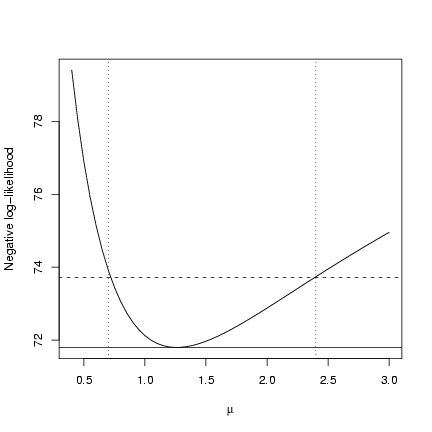
Plot it:

<div class="p"><!----></div>
  <font color="#FF0000">
<pre>
&#62;&nbsp;plot(muvec,&nbsp;mu.profile[,&nbsp;"NLL"],&nbsp;type&nbsp;=&nbsp;"l",&nbsp;xlab&nbsp;=&nbsp;expression(mu),&nbsp;
+&nbsp;&nbsp;&nbsp;&nbsp;&nbsp;ylab&nbsp;=&nbsp;"Negative&nbsp;log-likelihood")
&#62;&nbsp;cutoffs&nbsp;=&nbsp;c(0,&nbsp;qchisq(c(0.95),&nbsp;1)/2)
&#62;&nbsp;nll.levels&nbsp;=&nbsp;O1$value&nbsp;+&nbsp;cutoffs
&#62;&nbsp;abline(h&nbsp;=&nbsp;nll.levels,&nbsp;lty&nbsp;=&nbsp;1:2)
&#62;&nbsp;abline(v&nbsp;=&nbsp;ci.crude,&nbsp;lty&nbsp;=&nbsp;3)
&nbsp;
</pre> </font>

<div class="p"><!----></div>
<img src="lab6-026.png" alt="lab6-026.png" />

<div class="p"><!----></div>
You can see that it's not <em>exactly</em> on target,
but very close.  If you wanted to proceed in this
way and needed a more precise answer you could
"zoom in" and evaluate the profile on a finer
grid around the lower and upper confidence limits.

<div class="p"><!----></div>
</li>

<li>
You can set up an automatic search routine in  R&nbsp;to
try to find the confidence limits.  

<div class="p"><!----></div>
First, define a function that takes a particular
value of 
<math xmlns="http://www.w3.org/1998/Math/MathML">
<mrow><mi>&mu;</mi></mrow></math>, optimizes with respect to 
<math xmlns="http://www.w3.org/1998/Math/MathML">
<mrow><mi>k</mi></mrow></math>,
and returns the value of the negative log-likelihood
<em>minus the cutoff value</em>, which tells us how
far above or below the cutoff we are.

<div class="p"><!----></div>
   <font color="#FF0000">
<pre>
&#62;&nbsp;cutoff&nbsp;=&nbsp;O1$value&nbsp;+&nbsp;qchisq(c(0.95),&nbsp;1)/2
&#62;&nbsp;relheight&nbsp;=&nbsp;function(mu)&nbsp;{
+&nbsp;&nbsp;&nbsp;&nbsp;&nbsp;O2&nbsp;=&nbsp;optim(fn&nbsp;=&nbsp;NLLfun.mu,&nbsp;par&nbsp;=&nbsp;O1$par["k"],&nbsp;method&nbsp;=&nbsp;"L-BFGS-B",&nbsp;
+&nbsp;&nbsp;&nbsp;&nbsp;&nbsp;&nbsp;&nbsp;&nbsp;&nbsp;lower&nbsp;=&nbsp;0.002,&nbsp;mu&nbsp;=&nbsp;mu)
+&nbsp;&nbsp;&nbsp;&nbsp;&nbsp;O2$value&nbsp;-&nbsp;cutoff
+&nbsp;}
&nbsp;
</pre> </font>

<div class="p"><!----></div>
We know the lower limit is somewhere around 0.7, so going
on either side should give us values that are
negative/positive.

<div class="p"><!----></div>
  <font color="#FF0000">
<pre>
&#62;&nbsp;relheight(mu&nbsp;=&nbsp;0.6)
&nbsp;
</pre> </font>
  <font color="#0000FF">
<pre>
[1]&nbsp;1.420474

&nbsp;
</pre> </font>
  <font color="#FF0000">
<pre>
&#62;&nbsp;relheight(mu&nbsp;=&nbsp;0.8)
&nbsp;
</pre> </font>
  <font color="#0000FF">
<pre>
[1]&nbsp;-0.6530479

&nbsp;
</pre> </font>

<div class="p"><!----></div>
Using  R's <tt>uniroot</tt> function, which takes
a single-parameter function and searches for a value
that gives zero:

<div class="p"><!----></div>
  <font color="#FF0000">
<pre>
&#62;&nbsp;lower&nbsp;=&nbsp;uniroot(relheight,&nbsp;interval&nbsp;=&nbsp;c(0.5,&nbsp;1))$root
&#62;&nbsp;upper&nbsp;=&nbsp;uniroot(relheight,&nbsp;interval&nbsp;=&nbsp;c(1.2,&nbsp;5))$root
&#62;&nbsp;ci.uniroot&nbsp;=&nbsp;c(lower,&nbsp;upper)
&nbsp;
</pre> </font>

<div class="p"><!----></div>
   <font color="#FF0000">
<pre>
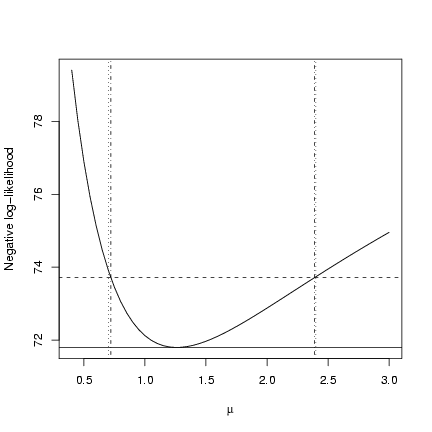
&#62;&nbsp;plot(muvec,&nbsp;mu.profile[,&nbsp;"NLL"],&nbsp;type&nbsp;=&nbsp;"l",&nbsp;xlab&nbsp;=&nbsp;expression(mu),&nbsp;
+&nbsp;&nbsp;&nbsp;&nbsp;&nbsp;ylab&nbsp;=&nbsp;"Negative&nbsp;log-likelihood")
&#62;&nbsp;cutoffs&nbsp;=&nbsp;c(0,&nbsp;qchisq(c(0.95),&nbsp;1)/2)
&#62;&nbsp;nll.levels&nbsp;=&nbsp;O1$value&nbsp;+&nbsp;cutoffs
&#62;&nbsp;abline(h&nbsp;=&nbsp;nll.levels,&nbsp;lty&nbsp;=&nbsp;1:2)
&#62;&nbsp;abline(v&nbsp;=&nbsp;ci.crude,&nbsp;lty&nbsp;=&nbsp;3)
&#62;&nbsp;abline(v&nbsp;=&nbsp;ci.uniroot,&nbsp;lty&nbsp;=&nbsp;4)
&nbsp;
</pre> </font>

<div class="p"><!----></div>
<img src="lab6-030.png" alt="lab6-030.png" />

<div class="p"><!----></div>
Slightly more precise than the previous solution.

<div class="p"><!----></div>
</li>

<li>
Using the information-based approach.
Here is
the information matrix:

<div class="p"><!----></div>
  <font color="#FF0000">
<pre>
&#62;&nbsp;O1$hessian
&nbsp;
</pre> </font>
  <font color="#0000FF">
<pre>
&nbsp;&nbsp;&nbsp;&nbsp;&nbsp;&nbsp;&nbsp;&nbsp;&nbsp;&nbsp;&nbsp;&nbsp;mu&nbsp;&nbsp;&nbsp;&nbsp;&nbsp;&nbsp;&nbsp;&nbsp;&nbsp;&nbsp;&nbsp;&nbsp;k
mu&nbsp;7.387808331&nbsp;&nbsp;0.004901569
k&nbsp;&nbsp;0.004901569&nbsp;97.372581408

&nbsp;
</pre> </font>

<div class="p"><!----></div>
Inverting the information matrix:

<div class="p"><!----></div>
  <font color="#FF0000">
<pre>
&#62;&nbsp;s1&nbsp;=&nbsp;solve(O1$hessian)
&#62;&nbsp;s1
&nbsp;
</pre> </font>
  <font color="#0000FF">
<pre>
&nbsp;&nbsp;&nbsp;&nbsp;&nbsp;&nbsp;&nbsp;&nbsp;&nbsp;&nbsp;&nbsp;&nbsp;&nbsp;&nbsp;mu&nbsp;&nbsp;&nbsp;&nbsp;&nbsp;&nbsp;&nbsp;&nbsp;&nbsp;&nbsp;&nbsp;&nbsp;&nbsp;k
mu&nbsp;&nbsp;1.353581e-01&nbsp;-6.813697e-06
k&nbsp;&nbsp;-6.813697e-06&nbsp;&nbsp;1.026983e-02

&nbsp;
</pre> </font>

<div class="p"><!----></div>
You can see that the off diagonal elements
are very small (
<math xmlns="http://www.w3.org/1998/Math/MathML">
<mrow><mo>-</mo><mn>6</mn><mo>&times;</mo>
<msup><mrow><mn>10</mn></mrow><mrow><mo>-</mo><mn>6</mn></mrow>
</msup>
</mrow></math> as opposed
to 0.0102 and 0.135 on the diagonal), correctly
suggesting that the parameter estimates are
uncorrelated.

<div class="p"><!----></div>
Suppose we want to approximate
the likelihood profile by the quadratic 
<math xmlns="http://www.w3.org/1998/Math/MathML">
<mrow><mi>L</mi><mo>=</mo><mi>a</mi><mo>+</mo><mi>c</mi><mo stretchy="false">(</mo><mi>&mu;</mi><mo>-</mo><mi>b</mi>
<msup><mrow><mo stretchy="false">)</mo></mrow><mrow><mn>2</mn></mrow>
</msup>
</mrow></math>.
The parameter 
<math xmlns="http://www.w3.org/1998/Math/MathML">
<mrow><mi>b</mi></mrow></math> governs the 
<math xmlns="http://www.w3.org/1998/Math/MathML">
<mrow><mi>&mu;</mi></mrow></math> value at
which the minimum occurs (so 
<math xmlns="http://www.w3.org/1998/Math/MathML">
<mrow><mi>b</mi></mrow></math> corresponds
to the MLE of 
<math xmlns="http://www.w3.org/1998/Math/MathML">
<mrow><mi>&mu;</mi></mrow></math>) and parameter 
<math xmlns="http://www.w3.org/1998/Math/MathML">
<mrow><mi>a</mi></mrow></math> 
governs the height of the minimum
(so 
<math xmlns="http://www.w3.org/1998/Math/MathML">
<mrow><mi>a</mi></mrow></math> is the minimum negative log-likelihood).
The second derivative of the quadratic
is 
<math xmlns="http://www.w3.org/1998/Math/MathML">
<mrow><mn>2</mn><mi>c</mi></mrow></math>; the second derivative of
the likelihood surface is

<math xmlns="http://www.w3.org/1998/Math/MathML">
<mrow>
<msup><mrow><mo>&part;</mo></mrow><mrow><mn>2</mn></mrow>
</msup>
<mi>L</mi><mo stretchy="false">/</mo><mo>&part;</mo>
<msup><mrow><mi>&mu;</mi></mrow><mrow><mn>2</mn></mrow>
</msup>
</mrow></math>,
so 
<math xmlns="http://www.w3.org/1998/Math/MathML">
<mrow><mi>c</mi><mo>=</mo><mo stretchy="false">(</mo>
<msup><mrow><mo>&part;</mo></mrow><mrow><mn>2</mn></mrow>
</msup>
<mi>L</mi><mo stretchy="false">/</mo><mo>&part;</mo>
<msup><mrow><mi>&mu;</mi></mrow><mrow><mn>2</mn></mrow>
</msup>
<mo stretchy="false">)</mo><mo stretchy="false">/</mo><mn>2</mn></mrow></math>.

<div class="p"><!----></div>
   <font color="#FF0000">
<pre>
&#62;&nbsp;a&nbsp;=&nbsp;O1$value
&#62;&nbsp;b&nbsp;=&nbsp;O1$par["mu"]
&#62;&nbsp;c&nbsp;=&nbsp;O1$hessian["mu",&nbsp;"mu"]/2
&nbsp;
</pre> </font>

<div class="p"><!----></div>
We get the variances of the
parameters
(
<math xmlns="http://www.w3.org/1998/Math/MathML">
<mrow>
<msubsup><mrow><mi>&sigma;</mi></mrow><mrow><mi>&mu;</mi> </mrow>
<mrow><mn>2</mn></mrow></msubsup>
</mrow></math>, 
<math xmlns="http://www.w3.org/1998/Math/MathML">
<mrow>
<msubsup><mrow><mi>&sigma;</mi></mrow><mrow><mi>k</mi> </mrow>
<mrow><mn>2</mn></mrow></msubsup>
</mrow></math>)
by inverting
the information matrix.
The size of the confidence limit
is 
<math xmlns="http://www.w3.org/1998/Math/MathML">
<mrow><mo>&PlusMinus;</mo><mn>1</mn><mo>.</mo><mn>96</mn>
<msub><mrow><mi>&sigma;</mi></mrow><mrow><mi>&mu;</mi></mrow>
</msub>
</mrow></math> for 95% 
confidence limits, or more generally

<math xmlns="http://www.w3.org/1998/Math/MathML">
<mrow><mo>&PlusMinus;</mo></mrow></math> <tt>qnorm(1-alpha/2)</tt> 
<math xmlns="http://www.w3.org/1998/Math/MathML">
<mrow>
<msub><mrow><mi>&sigma;</mi></mrow><mrow><mi>&mu;</mi></mrow>
</msub>
</mrow></math> (<tt>qnorm</tt>
gives the quantile of the standard normal,
with mean 0 and standard deviation 1, by
default).

<div class="p"><!----></div>
   <font color="#FF0000">
<pre>
&#62;&nbsp;se.mu&nbsp;=&nbsp;sqrt(s1["mu",&nbsp;"mu"])
&#62;&nbsp;ci.info&nbsp;=&nbsp;O1$par["mu"]&nbsp;+&nbsp;c(-1,&nbsp;1)&nbsp;*&nbsp;qnorm(0.975)&nbsp;*&nbsp;se.mu
&nbsp;
</pre> </font>

<div class="p"><!----></div>
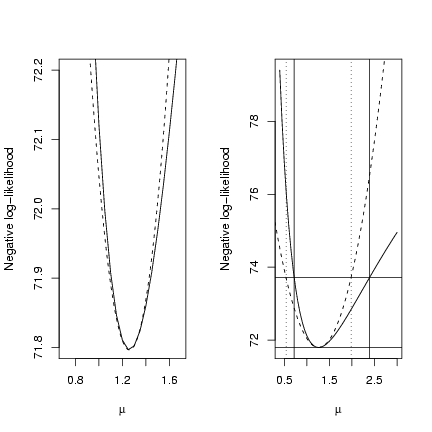
Double plot, showing a close-up of the negative
log-likelihood minimum (to convince you that
the quadratic approximation really is a good
fit if you go close enough to the minimum - this
is essentially a Taylor expansion, provided
that the likelihood surface is reasonably well-behaved)
and a wider view comparing the quadratic
approximation and the confidence limits based on

<div class="p"><!----></div>
  <font color="#FF0000">
<pre>
&#62;&nbsp;op&nbsp;=&nbsp;par(mfrow&nbsp;=&nbsp;c(1,&nbsp;2))
&#62;&nbsp;plot(muvec,&nbsp;mu.profile[,&nbsp;"NLL"],&nbsp;type&nbsp;=&nbsp;"l",&nbsp;xlab&nbsp;=&nbsp;expression(mu),&nbsp;
+&nbsp;&nbsp;&nbsp;&nbsp;&nbsp;ylab&nbsp;=&nbsp;"Negative&nbsp;log-likelihood",&nbsp;ylim&nbsp;=&nbsp;c(71.8,&nbsp;72.2),&nbsp;xlim&nbsp;=&nbsp;c(0.7,&nbsp;
+&nbsp;&nbsp;&nbsp;&nbsp;&nbsp;&nbsp;&nbsp;&nbsp;&nbsp;1.7))
&#62;&nbsp;curve(a&nbsp;+&nbsp;c&nbsp;*&nbsp;(x&nbsp;-&nbsp;b)^2,&nbsp;add&nbsp;=&nbsp;TRUE,&nbsp;lty&nbsp;=&nbsp;2)
&#62;&nbsp;plot(muvec,&nbsp;mu.profile[,&nbsp;"NLL"],&nbsp;type&nbsp;=&nbsp;"l",&nbsp;xlab&nbsp;=&nbsp;expression(mu),&nbsp;
+&nbsp;&nbsp;&nbsp;&nbsp;&nbsp;ylab&nbsp;=&nbsp;"Negative&nbsp;log-likelihood")
&#62;&nbsp;cutoffs&nbsp;=&nbsp;c(0,&nbsp;qchisq(c(0.95),&nbsp;1)/2)&nbsp;+&nbsp;O1$value
&#62;&nbsp;curve(a&nbsp;+&nbsp;c&nbsp;*&nbsp;(x&nbsp;-&nbsp;b)^2,&nbsp;add&nbsp;=&nbsp;TRUE,&nbsp;lty&nbsp;=&nbsp;2)
&#62;&nbsp;abline(h&nbsp;=&nbsp;cutoffs)
&#62;&nbsp;abline(v&nbsp;=&nbsp;ci.info,&nbsp;lty&nbsp;=&nbsp;3)
&#62;&nbsp;abline(v&nbsp;=&nbsp;ci.uniroot,&nbsp;lty&nbsp;=&nbsp;1)
&#62;&nbsp;par(op)
&nbsp;
</pre> </font>

<div class="p"><!----></div>
<img src="lab6-035.png" alt="lab6-035.png" />

<div class="p"><!----></div>
</li>

<li>
One way to cheat: use the <tt>fitdistr</tt> function
from the <tt>MASS</tt> package instead (this only
works for simple draws from distributions).

<div class="p"><!----></div>
  <font color="#FF0000">
<pre>
&#62;&nbsp;library(MASS)
&#62;&nbsp;f&nbsp;=&nbsp;fitdistr(x,&nbsp;"negative&nbsp;binomial")
&#62;&nbsp;f
&nbsp;
</pre> </font>
  <font color="#0000FF">
<pre>
&nbsp;&nbsp;&nbsp;&nbsp;&nbsp;size&nbsp;&nbsp;&nbsp;&nbsp;&nbsp;&nbsp;&nbsp;&nbsp;&nbsp;mu&nbsp;&nbsp;&nbsp;&nbsp;
&nbsp;&nbsp;0.2885187&nbsp;&nbsp;&nbsp;1.2597788&nbsp;
&nbsp;(0.1013610)&nbsp;(0.3676483)

&nbsp;
</pre> </font>

<div class="p"><!----></div>
<tt>fitdistr</tt> gives the parameters
in the other order - <tt>size</tt> and <tt>mu</tt>
rather than <tt>mu</tt> and <tt>k</tt> as I have been
naming them.
It gives standard errors <em>based on
the quadratic approximation</em>, so the same as by
the previous method.  (I had to use <tt>str(f)</tt>
to look inside <tt>f</tt> and figure out how
to extract the numbers I wanted.)

<div class="p"><!----></div>
   <font color="#FF0000">
<pre>
&#62;&nbsp;ci.fitdistr&nbsp;=&nbsp;f$estimate["mu"]&nbsp;+&nbsp;c(-1,&nbsp;1)&nbsp;*&nbsp;f$sd["mu"]&nbsp;*&nbsp;qnorm(0.975)
&nbsp;
</pre> </font>

<div class="p"><!----></div>

<div class="p"><!----></div>
</li>

<li>The last option is to use the <tt>mle</tt> function
from the <tt>stats4</tt> package to find the confidence intervals.
To do this, we have to rewrite the NLL function slightly
differently: (1) specify the parameters separately, rather
than packing them into a parameter vector (and then unpacking
them inside the function - so this is actually slightly
more convenient), and (2) you can't pass the data as additional
argument: if you want to run the function for another set of
data you have to replace <tt>x</tt> with your new data, or write
another function (there are other kinds of black magic
you can do to achieve the same goal, but they are too complicated
to lay out here (P2C2E [<a href="#Rushdie1999" name="CITERushdie1999">1</a>])).

<div class="p"><!----></div>
  <font color="#FF0000">
<pre>
&#62;&nbsp;NLLfun2&nbsp;=&nbsp;function(mu,&nbsp;k)&nbsp;{
+&nbsp;&nbsp;&nbsp;&nbsp;&nbsp;-sum(dnbinom(x,&nbsp;mu&nbsp;=&nbsp;mu,&nbsp;size&nbsp;=&nbsp;k,&nbsp;log&nbsp;=&nbsp;TRUE))
+&nbsp;}
&nbsp;
</pre> </font>

<div class="p"><!----></div>
<tt>mle</tt> has slightly different argument names from <tt>optim</tt>,
but you still have to specify the function and the starting values,
and you can include other options (which get passed straight
to <tt>optim</tt>):

<div class="p"><!----></div>
  <font color="#FF0000">
<pre>
&#62;&nbsp;library(stats4)
&#62;&nbsp;m1&nbsp;=&nbsp;mle(minuslogl&nbsp;=&nbsp;NLLfun2,&nbsp;start&nbsp;=&nbsp;list(mu&nbsp;=&nbsp;mu.mom,&nbsp;k&nbsp;=&nbsp;k.mom),&nbsp;
+&nbsp;&nbsp;&nbsp;&nbsp;&nbsp;method&nbsp;=&nbsp;"L-BFGS-B",&nbsp;lower&nbsp;=&nbsp;0.002)
&#62;&nbsp;m1
&nbsp;
</pre> </font>
  <font color="#0000FF">
<pre>

Call:
mle(minuslogl&nbsp;=&nbsp;NLLfun2,&nbsp;start&nbsp;=&nbsp;list(mu&nbsp;=&nbsp;mu.mom,&nbsp;k&nbsp;=&nbsp;k.mom),&nbsp;
&nbsp;&nbsp;&nbsp;&nbsp;method&nbsp;=&nbsp;"L-BFGS-B",&nbsp;lower&nbsp;=&nbsp;0.002)

Coefficients:
&nbsp;&nbsp;&nbsp;&nbsp;&nbsp;&nbsp;&nbsp;mu&nbsp;&nbsp;&nbsp;&nbsp;&nbsp;&nbsp;&nbsp;&nbsp;&nbsp;k&nbsp;
1.2600009&nbsp;0.2885231&nbsp;

&nbsp;
</pre> </font>

<div class="p"><!----></div>
<tt>summary(m1)</tt> gives the estimates and the standard errors
based on the quadratic approximation:

<div class="p"><!----></div>
  <font color="#FF0000">
<pre>
&#62;&nbsp;summary(m1)
&nbsp;
</pre> </font>
  <font color="#0000FF">
<pre>
Maximum&nbsp;likelihood&nbsp;estimation

Call:
mle(minuslogl&nbsp;=&nbsp;NLLfun2,&nbsp;start&nbsp;=&nbsp;list(mu&nbsp;=&nbsp;mu.mom,&nbsp;k&nbsp;=&nbsp;k.mom),&nbsp;
&nbsp;&nbsp;&nbsp;&nbsp;method&nbsp;=&nbsp;"L-BFGS-B",&nbsp;lower&nbsp;=&nbsp;0.002)

Coefficients:
&nbsp;&nbsp;&nbsp;&nbsp;Estimate&nbsp;Std.&nbsp;Error
mu&nbsp;1.2600009&nbsp;&nbsp;0.3677636
k&nbsp;&nbsp;0.2885231&nbsp;&nbsp;0.1013633

-2&nbsp;log&nbsp;L:&nbsp;143.5929&nbsp;

&nbsp;
</pre> </font>

<div class="p"><!----></div>
<tt>confint(m1)</tt> gives the profile confidence limits,
for all parameters (the second line below takes just the
row corresponding to <tt>mu</tt>).

<div class="p"><!----></div>
  <font color="#FF0000">
<pre>
&#62;&nbsp;ci.mle.all&nbsp;=&nbsp;confint(m1)
&nbsp;
</pre> </font>
  <font color="#0000FF">
<pre>
Profiling...

&nbsp;
</pre> </font>
  <font color="#FF0000">
<pre>
&#62;&nbsp;ci.mle.all
&nbsp;
</pre> </font>
  <font color="#0000FF">
<pre>
&nbsp;&nbsp;&nbsp;&nbsp;&nbsp;&nbsp;&nbsp;2.5&nbsp;%&nbsp;&nbsp;&nbsp;97.5&nbsp;%
mu&nbsp;0.7204352&nbsp;2.390998
k&nbsp;&nbsp;0.1437419&nbsp;0.579509

&nbsp;
</pre> </font>
  <font color="#FF0000">
<pre>
&#62;&nbsp;ci.mle&nbsp;=&nbsp;ci.mle.all["mu",&nbsp;]
&nbsp;
</pre> </font>

<div class="p"><!----></div>
The <tt>confint</tt> code is based on first calculating the
profile (as we did above, but at a smaller number
of points), then using spline-based interpolation
to find the intersections with the cutoff height.

<div class="p"><!----></div>
</li>
</ol>

<div class="p"><!----></div>
Comparing all of these methods:

<div class="p"><!----></div>
  <font color="#FF0000">
<pre>
&#62;&nbsp;citab&nbsp;=&nbsp;rbind(ci.crude,&nbsp;ci.uniroot,&nbsp;ci.mle,&nbsp;ci.info,&nbsp;ci.fitdistr)
&#62;&nbsp;citab
&nbsp;
</pre> </font>
  <font color="#0000FF">
<pre>
&nbsp;&nbsp;&nbsp;&nbsp;&nbsp;&nbsp;&nbsp;&nbsp;&nbsp;&nbsp;&nbsp;&nbsp;&nbsp;&nbsp;&nbsp;&nbsp;2.5&nbsp;%&nbsp;&nbsp;&nbsp;97.5&nbsp;%
ci.crude&nbsp;&nbsp;&nbsp;&nbsp;0.7000000&nbsp;2.400000
ci.uniroot&nbsp;&nbsp;0.7200252&nbsp;2.390702
ci.mle&nbsp;&nbsp;&nbsp;&nbsp;&nbsp;&nbsp;0.7204352&nbsp;2.390998
ci.info&nbsp;&nbsp;&nbsp;&nbsp;&nbsp;0.5391442&nbsp;1.981327
ci.fitdistr&nbsp;0.5392013&nbsp;1.980356

&nbsp;
</pre> </font>

<div class="p"><!----></div>
 <h2><a name="tth_sEc3">
3</a>&nbsp;&nbsp;Reef fish: settler distribution</h2>
Let's simulate the reef fish data again:

<div class="p"><!----></div>
   <font color="#FF0000">
<pre>
&#62;&nbsp;a&nbsp;=&nbsp;0.696
&#62;&nbsp;b&nbsp;=&nbsp;9.79
&#62;&nbsp;recrprob&nbsp;=&nbsp;function(x,&nbsp;a&nbsp;=&nbsp;0.696,&nbsp;b&nbsp;=&nbsp;9.79)&nbsp;a/(1&nbsp;+&nbsp;(a/b)&nbsp;*&nbsp;x)
&#62;&nbsp;scoefs&nbsp;=&nbsp;c(mu&nbsp;=&nbsp;25.32,&nbsp;k&nbsp;=&nbsp;0.932,&nbsp;zprob&nbsp;=&nbsp;0.123)
&#62;&nbsp;settlers&nbsp;=&nbsp;rzinbinom(603,&nbsp;mu&nbsp;=&nbsp;scoefs["mu"],&nbsp;size&nbsp;=&nbsp;scoefs["k"],&nbsp;
+&nbsp;&nbsp;&nbsp;&nbsp;&nbsp;zprob&nbsp;=&nbsp;scoefs["zprob"])
&#62;&nbsp;recr&nbsp;=&nbsp;rbinom(603,&nbsp;prob&nbsp;=&nbsp;recrprob(settlers),&nbsp;size&nbsp;=&nbsp;settlers)
&nbsp;
</pre> </font>

<div class="p"><!----></div>
Set up likelihood functions - let's say we know the numbers of
settlers and are trying to estimate the recruitment probability function.
I'll use <tt>mle</tt>.

<div class="p"><!----></div>
First, a Shepherd function:

<div class="p"><!----></div>
  <font color="#FF0000">
<pre>
&#62;&nbsp;NLLfun3&nbsp;=&nbsp;function(a,&nbsp;b,&nbsp;d)&nbsp;{
+&nbsp;&nbsp;&nbsp;&nbsp;&nbsp;recrprob&nbsp;=&nbsp;a/(1&nbsp;+&nbsp;(a/b)&nbsp;*&nbsp;settlers^d)
+&nbsp;&nbsp;&nbsp;&nbsp;&nbsp;-sum(dbinom(recr,&nbsp;prob&nbsp;=&nbsp;recrprob,&nbsp;size&nbsp;=&nbsp;settlers,&nbsp;log&nbsp;=&nbsp;TRUE),&nbsp;
+&nbsp;&nbsp;&nbsp;&nbsp;&nbsp;&nbsp;&nbsp;&nbsp;&nbsp;na.rm&nbsp;=&nbsp;TRUE)
+&nbsp;}
&nbsp;
</pre> </font>

<div class="p"><!----></div>
   <font color="#FF0000">
<pre>
&#62;&nbsp;NLLfun4&nbsp;=&nbsp;function(a,&nbsp;b)&nbsp;{
+&nbsp;&nbsp;&nbsp;&nbsp;&nbsp;recrprob&nbsp;=&nbsp;a/(1&nbsp;+&nbsp;(a/b)&nbsp;*&nbsp;settlers)
+&nbsp;&nbsp;&nbsp;&nbsp;&nbsp;-sum(dbinom(recr,&nbsp;prob&nbsp;=&nbsp;recrprob,&nbsp;size&nbsp;=&nbsp;settlers,&nbsp;log&nbsp;=&nbsp;TRUE),&nbsp;
+&nbsp;&nbsp;&nbsp;&nbsp;&nbsp;&nbsp;&nbsp;&nbsp;&nbsp;na.rm&nbsp;=&nbsp;TRUE)
+&nbsp;}
&nbsp;
</pre> </font>

<div class="p"><!----></div>
   <font color="#FF0000">
<pre>
&#62;&nbsp;NLLfun5&nbsp;=&nbsp;function(a)&nbsp;{
+&nbsp;&nbsp;&nbsp;&nbsp;&nbsp;recrprob&nbsp;=&nbsp;a
+&nbsp;&nbsp;&nbsp;&nbsp;&nbsp;-sum(dbinom(recr,&nbsp;prob&nbsp;=&nbsp;recrprob,&nbsp;size&nbsp;=&nbsp;settlers,&nbsp;log&nbsp;=&nbsp;TRUE),&nbsp;
+&nbsp;&nbsp;&nbsp;&nbsp;&nbsp;&nbsp;&nbsp;&nbsp;&nbsp;na.rm&nbsp;=&nbsp;TRUE)
+&nbsp;}
&nbsp;
</pre> </font>

<div class="p"><!----></div>
I ran into a problem with this log-likelihood function:
when settlers=0, the recruitment probability is 
<math xmlns="http://www.w3.org/1998/Math/MathML">
<mrow><mi>a</mi></mrow></math>,
which may be greater than 0.  This doesn't matter in 
reality because when there are zero settlers there
aren't any recruits.  From a statistical point of
view, the probability of zero recruits is 1 when
there are zero settlers, but <tt>dbinom(x,prob=a,size=0)</tt>
still comes out with <tt>NaN</tt>.  However, <b>since I
know what the problem is</b> and I know that the 
log-likelihood in this case is 
<math xmlns="http://www.w3.org/1998/Math/MathML">
<mrow><mi>log</mi><mo stretchy="false">(</mo><mn>1</mn><mo stretchy="false">)</mo><mo>=</mo><mn>0</mn></mrow></math> and
so contributes nothing to the log-likelihood,
I am safe using the <tt>na.rm=TRUE</tt> option
for <tt>sum</tt>.
However, this does still gives me warnings about
<tt>NaNs produced in: dbinom ... </tt>.  A better
solution might be to drop the zero-settler cases
from the data entirely:

<div class="p"><!----></div>
  <font color="#FF0000">
<pre>
&#62;&nbsp;recr&nbsp;=&nbsp;recr[settlers&nbsp;&#62;&nbsp;0]
&#62;&nbsp;settlers&nbsp;=&nbsp;settlers[settlers&nbsp;&#62;&nbsp;0]
&nbsp;
</pre> </font>

<div class="p"><!----></div>
   <font color="#FF0000">
<pre>
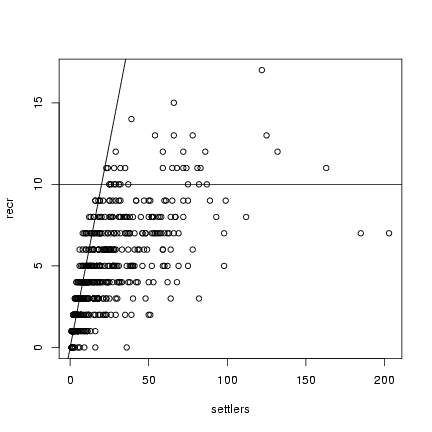
&#62;&nbsp;plot(settlers,&nbsp;recr)
&#62;&nbsp;abline(h&nbsp;=&nbsp;10)
&#62;&nbsp;abline(a&nbsp;=&nbsp;0,&nbsp;b&nbsp;=&nbsp;0.5)
&nbsp;
</pre> </font>

<div class="p"><!----></div>
<img src="lab6-048.png" alt="lab6-048.png" />

<div class="p"><!----></div>
Looking at a plot of the data, I can eyeball the asymptote (
<math xmlns="http://www.w3.org/1998/Math/MathML">
<mrow><mi>b</mi></mrow></math>) at about 10 recruits, the initial
slope (
<math xmlns="http://www.w3.org/1998/Math/MathML">
<mrow><mi>a</mi></mrow></math>) at about 0.5, and I'll start with 
<math xmlns="http://www.w3.org/1998/Math/MathML">
<mrow><mi>d</mi><mo>=</mo><mn>1</mn></mrow></math>.

<div class="p"><!----></div>
Had to mess around a bit - fitted the simpler (Beverton-Holt) model
first, and found I had to use <tt>L-BFGS-B</tt> to get <tt>mle</tt>
not to choke while computing the information matrix.

<div class="p"><!----></div>
  <font color="#FF0000">
<pre>
&#62;&nbsp;m4&nbsp;=&nbsp;mle(minuslogl&nbsp;=&nbsp;NLLfun4,&nbsp;start&nbsp;=&nbsp;list(a&nbsp;=&nbsp;0.5,&nbsp;b&nbsp;=&nbsp;10),&nbsp;
+&nbsp;&nbsp;&nbsp;&nbsp;&nbsp;method&nbsp;=&nbsp;"L-BFGS-B",&nbsp;lower&nbsp;=&nbsp;0.003)
&#62;&nbsp;s3&nbsp;=&nbsp;list(a&nbsp;=&nbsp;0.684,&nbsp;b&nbsp;=&nbsp;10.161,&nbsp;d&nbsp;=&nbsp;1)
&#62;&nbsp;m3&nbsp;=&nbsp;mle(minuslogl&nbsp;=&nbsp;NLLfun3,&nbsp;start&nbsp;=&nbsp;s3,&nbsp;method&nbsp;=&nbsp;"L-BFGS-B",&nbsp;
+&nbsp;&nbsp;&nbsp;&nbsp;&nbsp;lower&nbsp;=&nbsp;0.003)
&#62;&nbsp;m5&nbsp;=&nbsp;mle(minuslogl&nbsp;=&nbsp;NLLfun5,&nbsp;start&nbsp;=&nbsp;list(a&nbsp;=&nbsp;0.5),&nbsp;method&nbsp;=&nbsp;"L-BFGS-B",&nbsp;
+&nbsp;&nbsp;&nbsp;&nbsp;&nbsp;lower&nbsp;=&nbsp;0.003)
&nbsp;
</pre> </font>

<div class="p"><!----></div>
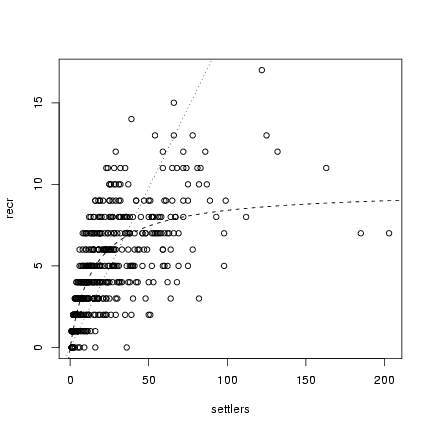
Plot all fits against the data:

<div class="p"><!----></div>
  <font color="#FF0000">
<pre>
&#62;&nbsp;plot(settlers,&nbsp;recr)
&#62;&nbsp;a&nbsp;=&nbsp;coef(m5)["a"]
&#62;&nbsp;curve(a&nbsp;*&nbsp;x,&nbsp;add&nbsp;=&nbsp;TRUE,&nbsp;lty&nbsp;=&nbsp;3)
&#62;&nbsp;a&nbsp;=&nbsp;coef(m4)["a"]
&#62;&nbsp;b&nbsp;=&nbsp;coef(m4)["b"]
&#62;&nbsp;curve(a&nbsp;*&nbsp;x/(1&nbsp;+&nbsp;(a/b)&nbsp;*&nbsp;x),&nbsp;add&nbsp;=&nbsp;TRUE,&nbsp;lty&nbsp;=&nbsp;2)
&#62;&nbsp;a&nbsp;=&nbsp;coef(m5)["a"]
&#62;&nbsp;b&nbsp;=&nbsp;coef(m5)["b"]
&#62;&nbsp;d&nbsp;=&nbsp;coef(m5)["d"]
&#62;&nbsp;curve(a&nbsp;*&nbsp;x/(1&nbsp;+&nbsp;(a/b)&nbsp;*&nbsp;x^d),&nbsp;add&nbsp;=&nbsp;TRUE,&nbsp;lty&nbsp;=&nbsp;3)
&nbsp;
</pre> </font>

<div class="p"><!----></div>
<img src="lab6-050.png" alt="lab6-050.png" />

<div class="p"><!----></div>
Compare the negative log-likelihoods:

<div class="p"><!----></div>
  <font color="#FF0000">
<pre>
&#62;&nbsp;nll&nbsp;=&nbsp;c(shep&nbsp;=&nbsp;-logLik(m3),&nbsp;BH&nbsp;=&nbsp;-logLik(m4),&nbsp;densind&nbsp;=&nbsp;-logLik(m5))
&#62;&nbsp;nll
&nbsp;
</pre> </font>
  <font color="#0000FF">
<pre>
&nbsp;&nbsp;&nbsp;&nbsp;shep&nbsp;&nbsp;&nbsp;&nbsp;&nbsp;&nbsp;&nbsp;BH&nbsp;&nbsp;densind&nbsp;
1020.427&nbsp;1020.843&nbsp;1444.717&nbsp;

&nbsp;
</pre> </font>

<div class="p"><!----></div>
As required, the Shepherd has a better likelihood than
the Beverton-Holt, but only by a tiny amount - certainly
not greater than the LRT cutoff.  On the other hand,
there is <em>extremely</em> strong support for density-dependence,
from the 424 log-likelihood-unit
differences between the density-independent and Beverton-Holt
model likelihoods.  It's silly, but you can calculate
the logarithm of the 
<math xmlns="http://www.w3.org/1998/Math/MathML">
<mrow><mi>p</mi></mrow></math>-value as:

<div class="p"><!----></div>
  <font color="#FF0000">
<pre>
&#62;&nbsp;logp&nbsp;=&nbsp;pchisq(2&nbsp;*&nbsp;nll[3]&nbsp;-&nbsp;nll[2],&nbsp;1,&nbsp;lower.tail&nbsp;=&nbsp;FALSE,&nbsp;log.p&nbsp;=&nbsp;TRUE)
&#62;&nbsp;logp
&nbsp;
</pre> </font>
  <font color="#0000FF">
<pre>
&nbsp;densind&nbsp;
-938.288&nbsp;

&nbsp;
</pre> </font>

<div class="p"><!----></div>
That's equivalent to 
<math xmlns="http://www.w3.org/1998/Math/MathML">
<mrow><mi>p</mi><mo>&ap;</mo>
<msup><mrow><mn>10</mn></mrow><mrow>-<mn>407</mn><mo>.</mo><mn>36822402525</mn></mrow>
</msup>
</mrow></math>
(there's a <em>much</em> higher probability that the CIA broke into
your computer and tampered with your data).

<div class="p"><!----></div>
We would get the same answer by calculating AIC values:

<div class="p"><!----></div>
  <font color="#FF0000">
<pre>
&#62;&nbsp;npar&nbsp;=&nbsp;c(5,&nbsp;4,&nbsp;3)
&#62;&nbsp;aic&nbsp;=&nbsp;nll&nbsp;+&nbsp;2&nbsp;*&nbsp;npar
&#62;&nbsp;aic
&nbsp;
</pre> </font>
  <font color="#0000FF">
<pre>
&nbsp;&nbsp;&nbsp;&nbsp;shep&nbsp;&nbsp;&nbsp;&nbsp;&nbsp;&nbsp;&nbsp;BH&nbsp;&nbsp;densind&nbsp;
1030.427&nbsp;1028.843&nbsp;1450.717&nbsp;

&nbsp;
</pre> </font>

<div class="p"><!----></div>
Or BIC values:

<div class="p"><!----></div>
  <font color="#FF0000">
<pre>
&#62;&nbsp;ndata&nbsp;=&nbsp;length(recr)
&#62;&nbsp;bic&nbsp;=&nbsp;nll&nbsp;+&nbsp;log(ndata)&nbsp;*&nbsp;npar
&#62;&nbsp;bic
&nbsp;
</pre> </font>
  <font color="#0000FF">
<pre>
&nbsp;&nbsp;&nbsp;&nbsp;shep&nbsp;&nbsp;&nbsp;&nbsp;&nbsp;&nbsp;&nbsp;BH&nbsp;&nbsp;densind&nbsp;
1051.609&nbsp;1045.788&nbsp;1463.426&nbsp;

&nbsp;
</pre> </font>

<div class="p"><!----></div>
(except that BIC says more strongly that
the Shepherd is not worth considering in this case).

<div class="p"><!----></div>
The confidence intervals tell the same story:

<div class="p"><!----></div>
  <font color="#FF0000">
<pre>
&#62;&nbsp;confint(m3)
&nbsp;
</pre> </font>
  <font color="#0000FF">
<pre>
Profiling...
&nbsp;&nbsp;&nbsp;&nbsp;&nbsp;&nbsp;2.5&nbsp;%&nbsp;&nbsp;&nbsp;&nbsp;&nbsp;97.5&nbsp;%
a&nbsp;0.5804655&nbsp;&nbsp;0.8629449
b&nbsp;4.5161010&nbsp;13.2424549
d&nbsp;0.8183632&nbsp;&nbsp;1.0738295

&nbsp;
</pre> </font>

<div class="p"><!----></div>
the 95% confidence intervals of 
<math xmlns="http://www.w3.org/1998/Math/MathML">
<mrow><mi>d</mi></mrow></math> include 1 (just).

<div class="p"><!----></div>
   <font color="#FF0000">
<pre>
&#62;&nbsp;confint(m4)
&nbsp;
</pre> </font>
  <font color="#0000FF">
<pre>
Profiling...
&nbsp;&nbsp;&nbsp;&nbsp;&nbsp;&nbsp;2.5&nbsp;%&nbsp;&nbsp;&nbsp;&nbsp;&nbsp;97.5&nbsp;%
a&nbsp;0.5833164&nbsp;&nbsp;0.7180549
b&nbsp;8.9412876&nbsp;10.4844295

&nbsp;
</pre> </font>

<div class="p"><!----></div>
We get tighter bounds on 
<math xmlns="http://www.w3.org/1998/Math/MathML">
<mrow><mi>a</mi></mrow></math> with the Beverton-Holt
model (since we are not wasting data trying to
estimate 
<math xmlns="http://www.w3.org/1998/Math/MathML">
<mrow><mi>d</mi></mrow></math>), and we get reasonable bounds on

<math xmlns="http://www.w3.org/1998/Math/MathML">
<mrow><mi>b</mi></mrow></math>.  (When I used <tt>BFGS</tt> instead of 
<tt>L-BFGS-B</tt>, even though I got reasonable
answers for the MLE, I ran into trouble
when I tried to get profile confidence limits.)
In particular, the upper confidence interval
of 
<math xmlns="http://www.w3.org/1998/Math/MathML">
<mrow><mi>b</mi></mrow></math> is 
<math xmlns="http://www.w3.org/1998/Math/MathML">
<mrow><mo>&lt;</mo><mi>&infin;</mi></mrow></math> (which it would not be
if the density-independent model were a better
fit).

<div class="p"><!----></div>
<b>Exercise 2:</b>
redo the fitting exercise, but instead of
using <tt>L-BFGS-B</tt>, fit log 
<math xmlns="http://www.w3.org/1998/Math/MathML">
<mrow><mi>a</mi></mrow></math>,
log 
<math xmlns="http://www.w3.org/1998/Math/MathML">
<mrow><mi>b</mi></mrow></math>, and log 
<math xmlns="http://www.w3.org/1998/Math/MathML">
<mrow><mi>d</mi></mrow></math> to avoid having
to use constrained optimization.
Back-transform your answers 
for the point estimates and the
confidence limits by exponentiating;
make sure they check closely with
the answers above.

<div class="p"><!----></div>
<b>Exercise 3:</b>
fit zero-inflated negative binomial,
negative binomial, and Poisson distributions
to the settler data.  State how the
three models are nested; perform
model selection by AIC and LRT, and
compare the confidence intervals
of the parameters.
What happens if you simulate half
as much "data"?

<div class="p"><!----></div>

<h2>References</h2>

<dl compact="compact">
 <dt><a href="#CITERushdie1999" name="Rushdie1999">[1]</a></dt><dd>
Salman Rushdie.
 <em>Haroun and the Sea of Stories</em>.
 Faber &amp; Faber, 1999.</dd>
</dl>


<br /><br /><hr /><small>File translated from
T<sub><font size="-1">E</font></sub>X
by <a href="http://hutchinson.belmont.ma.us/tth/">
T<sub><font size="-1">T</font></sub>M</a>,
version 3.70.<br />On 20 Oct 2005, 02:12.</small>
</body></html>