<?xml version="1.0"?>
<!DOCTYPE html    PUBLIC "-//W3C//DTD XHTML 1.1 plus MathML 2.0//EN"
           "http://www.w3.org/Math/DTD/mathml2/xhtml-math11-f.dtd">
<html xmlns="http://www.w3.org/1999/xhtml">
<head>
<meta name="GENERATOR" content="TtM 3.70" />
 <style type="text/css">
 div.p { margin-top: 7pt; }
 span.roman {font-family: serif; font-style: normal; font-weight: normal;} 
</style>


<title> Lab 5: stochastic simulation </title>
</head>
<body>
 
<h1 align="center">Lab 5: stochastic simulation </h1>

<h3 align="center">Ben Bolker </h3>

 &#169; 2005 Ben Bolker

<div class="p"><!----></div>
 <h2><a name="tth_sEc1">
1</a>&nbsp;&nbsp;Static simulation models</h2>

<div class="p"><!----></div>
     <h3><a name="tth_sEc1.1">
1.1</a>&nbsp;&nbsp;Simple models</h3>

<div class="p"><!----></div>
      <h4><a name="tth_sEc1.1.1">
1.1.1</a>&nbsp;&nbsp;Linear model</h4>
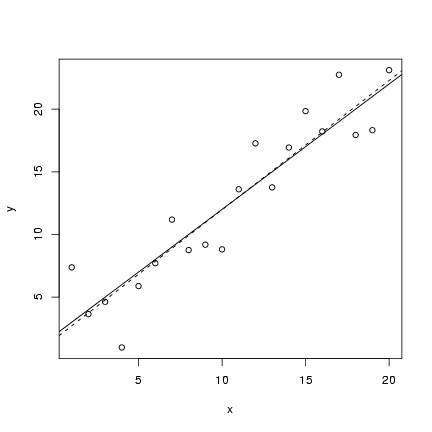
The code for the static linear model should (I hope)
seem pretty straightforward by now.
I defined an <tt>x</tt> vector, evenly spaced between
1 and 20; set up parameter values; calculated
a deterministic value; and then added 20
random normally distributed values to the
deterministic values.  I then plotted
a scatterplot (<tt>plot()</tt>) and added
both the theoretical value of the 
line (<tt>abline</tt> in its slope-intercept form)
and the fitted linear regression line
(<tt>lm(y~x)</tt>, as seen in Lab&nbsp;1).

<div class="p"><!----></div>
Pick 
<math xmlns="http://www.w3.org/1998/Math/MathML">
<mrow><mi>x</mi></mrow></math> values and set parameters:

<div class="p"><!----></div>
  <font color="#FF0000">
<pre>
&#62;&nbsp;x&nbsp;=&nbsp;1:20
&#62;&nbsp;a&nbsp;=&nbsp;2
&#62;&nbsp;b&nbsp;=&nbsp;1
&nbsp;
</pre> </font>

<div class="p"><!----></div>
Set random-number seed:

<div class="p"><!----></div>
  <font color="#FF0000">
<pre>
&#62;&nbsp;set.seed(1001)
&nbsp;
</pre> </font>

<div class="p"><!----></div>
Calculate the deterministic expectation
(<tt>y_det</tt>) and then pick 20 normally
distributed values with these means
and 
<math xmlns="http://www.w3.org/1998/Math/MathML">
<mrow><mi>&sigma;</mi><mo>=</mo><mn>2</mn></mrow></math>:

<div class="p"><!----></div>
  <font color="#FF0000">
<pre>
&#62;&nbsp;y_det&nbsp;=&nbsp;a&nbsp;+&nbsp;b&nbsp;*&nbsp;x
&#62;&nbsp;y&nbsp;=&nbsp;rnorm(20,&nbsp;mean&nbsp;=&nbsp;y_det,&nbsp;sd&nbsp;=&nbsp;2)
&nbsp;
</pre> </font>

<div class="p"><!----></div>
Plot the simulated values along with
the estimated linear regression line
and the theoretical values:

<div class="p"><!----></div>
  <font color="#FF0000">
<pre>
&#62;&nbsp;plot(x,&nbsp;y)
&#62;&nbsp;abline(lm(y&nbsp;~&nbsp;x),&nbsp;lty&nbsp;=&nbsp;2)
&#62;&nbsp;abline(a,&nbsp;b)
&nbsp;
</pre> </font>

<div class="p"><!----></div>
<img src="lab5-004.png" alt="lab5-004.png" />
(<tt>lines(x,y_det)</tt> would have the same
effect as the last statement).

<div class="p"><!----></div>
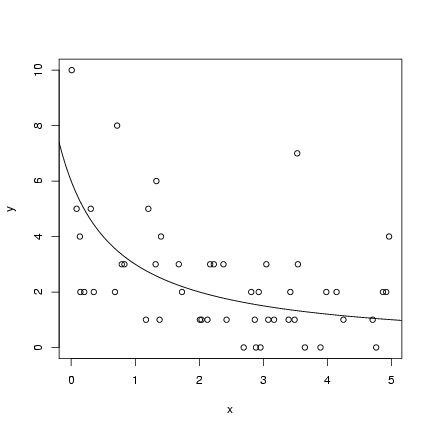
For the hyperbolic simulation:
Pick parameters:

<div class="p"><!----></div>
  <font color="#FF0000">
<pre>
&#62;&nbsp;a&nbsp;=&nbsp;6
&#62;&nbsp;b&nbsp;=&nbsp;1
&nbsp;
</pre> </font>

<div class="p"><!----></div>
Pick 50 
<math xmlns="http://www.w3.org/1998/Math/MathML">
<mrow><mi>x</mi></mrow></math> values uniformly distributed between 0 and 5:

<div class="p"><!----></div>
  <font color="#FF0000">
<pre>
&#62;&nbsp;x&nbsp;=&nbsp;runif(50,&nbsp;min&nbsp;=&nbsp;0,&nbsp;max&nbsp;=&nbsp;5)
&nbsp;
</pre> </font>

<div class="p"><!----></div>
Calculate the deterministic expectation
(<tt>y_det</tt>) and then pick 50 Poisson values
with these means:

<div class="p"><!----></div>
  <font color="#FF0000">
<pre>
&#62;&nbsp;y_det&nbsp;=&nbsp;a/(b&nbsp;+&nbsp;x)
&#62;&nbsp;y&nbsp;=&nbsp;rpois(50,&nbsp;y_det)
&nbsp;
</pre> </font>

<div class="p"><!----></div>
Plot the simulated values and add the
theoretical curve (we'll wait until Chapter&nbsp;6
to see how to estimate the curve):

<div class="p"><!----></div>
  <font color="#FF0000">
<pre>
&#62;&nbsp;plot(x,&nbsp;y)
&#62;&nbsp;curve(a/(b&nbsp;+&nbsp;x),&nbsp;add&nbsp;=&nbsp;TRUE)
&nbsp;
</pre> </font>

<div class="p"><!----></div>
<img src="lab5-008.png" alt="lab5-008.png" />

<div class="p"><!----></div>
<b>Exercise  1:</b>
Simulate a set of 100 values with

<ul>
<li>
<math xmlns="http://www.w3.org/1998/Math/MathML">
<mrow><mi>x</mi></mrow></math> values uniformly distributed between 0 and 10;
<div class="p"><!----></div>
</li>

<li>mean 
<math xmlns="http://www.w3.org/1998/Math/MathML">
<mrow><mi>y</mi></mrow></math> values following a Ricker model
with 
<math xmlns="http://www.w3.org/1998/Math/MathML">
<mrow><mi>a</mi></mrow></math> (initial slope) = 1 and 
<math xmlns="http://www.w3.org/1998/Math/MathML">
<mrow><mi>b</mi></mrow></math> (exponential
decay parameter) = 0.5;
<div class="p"><!----></div>
</li>

<li>gamma-distributed heterogeneity with shape parameter 3
and mean as above
<div class="p"><!----></div>
</li>
</ul>
Plot the simulated values and superimpose the theoretical
curve.

<div class="p"><!----></div>
 <h2><a name="tth_sEc2">
2</a>&nbsp;&nbsp;Intermediate simulations</h2>

<div class="p"><!----></div>
     <h3><a name="tth_sEc2.1">
2.1</a>&nbsp;&nbsp;Pigweed</h3>

<div class="p"><!----></div>
  <font color="#FF0000">
<pre>
&#62;&nbsp;set.seed(1001)
&#62;&nbsp;nparents&nbsp;=&nbsp;50
&#62;&nbsp;noffspr&nbsp;=&nbsp;10
&#62;&nbsp;L&nbsp;=&nbsp;30
&nbsp;
</pre> </font>

<div class="p"><!----></div>
Pick locations of parents:

<div class="p"><!----></div>
  <font color="#FF0000">
<pre>
&#62;&nbsp;parent_x&nbsp;=&nbsp;runif(nparents,&nbsp;min&nbsp;=&nbsp;0,&nbsp;max&nbsp;=&nbsp;L)
&#62;&nbsp;parent_y&nbsp;=&nbsp;runif(nparents,&nbsp;min&nbsp;=&nbsp;0,&nbsp;max&nbsp;=&nbsp;L)
&nbsp;
</pre> </font>

<div class="p"><!----></div>
Pick angles and distances of offsets of
offspring from parents:

<div class="p"><!----></div>
  <font color="#FF0000">
<pre>
&#62;&nbsp;angle&nbsp;=&nbsp;runif(nparents&nbsp;*&nbsp;noffspr,&nbsp;min&nbsp;=&nbsp;0,&nbsp;max&nbsp;=&nbsp;2&nbsp;*&nbsp;pi)
&#62;&nbsp;dist&nbsp;=&nbsp;rexp(nparents&nbsp;*&nbsp;noffspr,&nbsp;0.5)
&nbsp;
</pre> </font>

<div class="p"><!----></div>
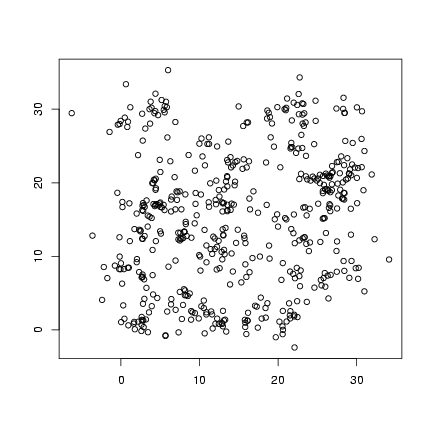
Calculate offspring locations (duplicating each
parent's position <tt>noffspr</tt> times):

<div class="p"><!----></div>
  <font color="#FF0000">
<pre>
&#62;&nbsp;offspr_x&nbsp;=&nbsp;rep(parent_x,&nbsp;each&nbsp;=&nbsp;noffspr)&nbsp;+&nbsp;cos(angle)&nbsp;*&nbsp;dist
&#62;&nbsp;offspr_y&nbsp;=&nbsp;rep(parent_y,&nbsp;each&nbsp;=&nbsp;noffspr)&nbsp;+&nbsp;sin(angle)&nbsp;*&nbsp;dist
&nbsp;
</pre> </font>

<div class="p"><!----></div>
Calculate distances:

<div class="p"><!----></div>
  <font color="#FF0000">
<pre>
&#62;&nbsp;dist&nbsp;=&nbsp;sqrt((outer(offspr_x,&nbsp;offspr_x,&nbsp;"-"))^2&nbsp;+&nbsp;(outer(offspr_y,&nbsp;
+&nbsp;&nbsp;&nbsp;&nbsp;&nbsp;offspr_y,&nbsp;"-"))^2)
&nbsp;
</pre> </font>

<div class="p"><!----></div>
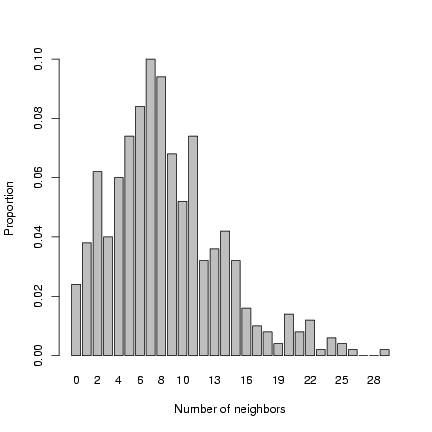
Calculate neighborhood crowding matrix:

<div class="p"><!----></div>
  <font color="#FF0000">
<pre>
&#62;&nbsp;nbrcrowd&nbsp;=&nbsp;apply(dist&nbsp;&lt;&nbsp;2,&nbsp;1,&nbsp;sum)&nbsp;-&nbsp;1
&nbsp;
</pre> </font>

<div class="p"><!----></div>
Plot offspring locations:

<div class="p"><!----></div>
  <font color="#FF0000">
<pre>
&#62;&nbsp;plot(offspr_x,&nbsp;offspr_y,&nbsp;xlab&nbsp;=&nbsp;"",&nbsp;ylab&nbsp;=&nbsp;"")
&nbsp;
</pre> </font>

<div class="p"><!----></div>
<img src="lab5-016.png" alt="lab5-016.png" />

<div class="p"><!----></div>
Plot distribution of neighborhood crowding:

<div class="p"><!----></div>
  <font color="#FF0000">
<pre>
&#62;&nbsp;b1&nbsp;=&nbsp;barplot(table(factor(nbrcrowd,&nbsp;levels&nbsp;=&nbsp;0:max(nbrcrowd)))/length(nbrcrowd),&nbsp;
+&nbsp;&nbsp;&nbsp;&nbsp;&nbsp;xlab&nbsp;=&nbsp;"Number&nbsp;of&nbsp;neighbors",&nbsp;ylab&nbsp;=&nbsp;"Proportion")
&nbsp;
</pre> </font>

<div class="p"><!----></div>
<img src="lab5-017.png" alt="lab5-017.png" />

<div class="p"><!----></div>
<b>Exercise  2</b>: superimpose a negative binomial
distribution, with the parameters estimated by the method
of moments, on the previous plot.

<div class="p"><!----></div>
Calculate crowding index as 3 
<math xmlns="http://www.w3.org/1998/Math/MathML">
<mrow><mo>&times;</mo></mrow></math> neighborhood density:

<div class="p"><!----></div>
  <font color="#FF0000">
<pre>
&#62;&nbsp;ci&nbsp;=&nbsp;nbrcrowd&nbsp;*&nbsp;3
&nbsp;
</pre> </font>

<div class="p"><!----></div>
Take parameter of hyperbolic function 
and gamma shape parameter from Pacala and Silander:

<div class="p"><!----></div>
  <font color="#FF0000">
<pre>
&#62;&nbsp;M&nbsp;=&nbsp;2.3
&#62;&nbsp;alpha&nbsp;=&nbsp;0.49
&nbsp;
</pre> </font>

<div class="p"><!----></div>
Expected value of biomass/
<math xmlns="http://www.w3.org/1998/Math/MathML">
<mrow><mi>&alpha;</mi></mrow></math> (note that
Pacala and Silander estimate the scale parameter
as a function of crowding index, not the mean):  

<div class="p"><!----></div>
  <font color="#FF0000">
<pre>
&#62;&nbsp;mass_det&nbsp;=&nbsp;M/(1&nbsp;+&nbsp;ci)
&nbsp;
</pre> </font>

<div class="p"><!----></div>
Pick random deviates:

<div class="p"><!----></div>
  <font color="#FF0000">
<pre>
&#62;&nbsp;mass&nbsp;=&nbsp;rgamma(length(mass_det),&nbsp;scale&nbsp;=&nbsp;mass_det,&nbsp;shape&nbsp;=&nbsp;alpha)
&nbsp;
</pre> </font>

<div class="p"><!----></div>
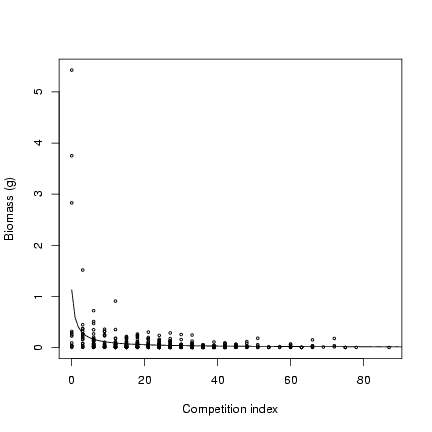
Plot values and theoretical curve:

<div class="p"><!----></div>
  <font color="#FF0000">
<pre>
&#62;&nbsp;plot(ci,&nbsp;mass,&nbsp;cex&nbsp;=&nbsp;0.5,&nbsp;xlab&nbsp;=&nbsp;"Competition&nbsp;index",&nbsp;ylab&nbsp;=&nbsp;"Biomass&nbsp;(g)")
&#62;&nbsp;curve(M/(1&nbsp;+&nbsp;x)&nbsp;*&nbsp;alpha,&nbsp;add&nbsp;=&nbsp;TRUE,&nbsp;from&nbsp;=&nbsp;0)
&nbsp;
</pre> </font>

<div class="p"><!----></div>
<img src="lab5-022.png" alt="lab5-022.png" />

<div class="p"><!----></div>
Parameters for seed set model (slope and overdispersion):

<div class="p"><!----></div>
  <font color="#FF0000">
<pre>
&#62;&nbsp;b&nbsp;=&nbsp;271.6
&#62;&nbsp;k&nbsp;=&nbsp;0.569
&nbsp;
</pre> </font>

<div class="p"><!----></div>
Deterministic model and random values:

<div class="p"><!----></div>
  <font color="#FF0000">
<pre>
&#62;&nbsp;seed_det&nbsp;=&nbsp;b&nbsp;*&nbsp;mass
&#62;&nbsp;seed&nbsp;=&nbsp;rnbinom(length(seed_det),&nbsp;mu&nbsp;=&nbsp;seed_det,&nbsp;size&nbsp;=&nbsp;k)
&nbsp;
</pre> </font>

<div class="p"><!----></div>
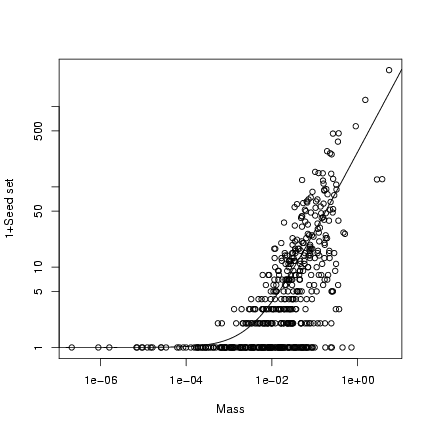
Plot (1+seed set) on a double-logarithmic scale:

<div class="p"><!----></div>
  <font color="#FF0000">
<pre>
&#62;&nbsp;plot(mass,&nbsp;1&nbsp;+&nbsp;seed,&nbsp;log&nbsp;=&nbsp;"xy",&nbsp;xlab&nbsp;=&nbsp;"Mass",&nbsp;ylab&nbsp;=&nbsp;"1+Seed&nbsp;set")
&#62;&nbsp;curve(b&nbsp;*&nbsp;x&nbsp;+&nbsp;1,&nbsp;add&nbsp;=&nbsp;TRUE)
&nbsp;
</pre> </font>

<div class="p"><!----></div>
<img src="lab5-025.png" alt="lab5-025.png" />

<div class="p"><!----></div>
Extra stuff: superimpose the 95% confidence limits on the plot
(use a logarithmically spaced 
<math xmlns="http://www.w3.org/1998/Math/MathML">
<mrow><mi>x</mi></mrow></math> vector to calculate them):

<div class="p"><!----></div>
  <font color="#FF0000">
<pre>
&#62;&nbsp;logxvec&nbsp;=&nbsp;seq(-7,&nbsp;0,&nbsp;length&nbsp;=&nbsp;100)
&#62;&nbsp;xvec&nbsp;=&nbsp;10^logxvec
&#62;&nbsp;lower&nbsp;=&nbsp;qnbinom(0.025,&nbsp;mu&nbsp;=&nbsp;b&nbsp;*&nbsp;xvec,&nbsp;size&nbsp;=&nbsp;k)
&#62;&nbsp;upper&nbsp;=&nbsp;qnbinom(0.975,&nbsp;mu&nbsp;=&nbsp;b&nbsp;*&nbsp;xvec,&nbsp;size&nbsp;=&nbsp;k)
&#62;&nbsp;lines(xvec,&nbsp;lower&nbsp;+&nbsp;1,&nbsp;lty&nbsp;=&nbsp;2)
&#62;&nbsp;lines(xvec,&nbsp;upper&nbsp;+&nbsp;1,&nbsp;lty&nbsp;=&nbsp;2)
&nbsp;
</pre> </font>

<div class="p"><!----></div>
<b>Exercise  3</b>: superimpose the
median of the distribution on the above graph as well: how
does it differ from the mean?

<div class="p"><!----></div>
<b>Exercise  4*</b>: reproduce Figure 3.<br />
<font size="+1"><b>or</b></font> <br />
<b>Exercise  5**</b>: reproduce Figure 3, but with
a beta-binomial error structure instead of a binomial error
structure.  Use Morris's parameterization of the beta-binomial,
with 
<math xmlns="http://www.w3.org/1998/Math/MathML">
<mrow><mi>p</mi></mrow></math> equal to the hyperbolic <em>per capita</em> recruitment
function (
<math xmlns="http://www.w3.org/1998/Math/MathML">
<mrow><mi>R</mi><mo stretchy="false">/</mo><mi>S</mi><mo>=</mo><mi>a</mi><mo stretchy="false">/</mo><mo stretchy="false">(</mo><mn>1</mn><mo>+</mo><mo stretchy="false">(</mo><mi>a</mi><mo stretchy="false">/</mo><mi>b</mi><mo stretchy="false">)</mo><mi>S</mi></mrow></math>) and 
<math xmlns="http://www.w3.org/1998/Math/MathML">
<mrow><mi>&theta;</mi><mo>=</mo><mn>10</mn></mrow></math>.

<div class="p"><!----></div>
 <h2><a name="tth_sEc3">
3</a>&nbsp;&nbsp;Dynamic models</h2>

<div class="p"><!----></div>
     <h3><a name="tth_sEc3.1">
3.1</a>&nbsp;&nbsp;Discrete time</h3>

<div class="p"><!----></div>
      <h4><a name="tth_sEc3.1.1">
3.1.1</a>&nbsp;&nbsp;Linear growth model</h4>

<div class="p"><!----></div>
Set up parameters: number of time steps,
starting value, change in 
<math xmlns="http://www.w3.org/1998/Math/MathML">
<mrow><mi>N</mi></mrow></math> per unit
time (slope), and standard deviations of
process and measurement error:

<div class="p"><!----></div>
  <font color="#FF0000">
<pre>
&#62;&nbsp;nt&nbsp;=&nbsp;20
&#62;&nbsp;N0&nbsp;=&nbsp;2
&#62;&nbsp;dN&nbsp;=&nbsp;1
&#62;&nbsp;sd_process&nbsp;=&nbsp;sqrt(2)
&#62;&nbsp;sd_obs&nbsp;=&nbsp;sqrt(2)
&nbsp;
</pre> </font>

<div class="p"><!----></div>
The first way to do this problem:
marginally less efficient but perhaps
easier to understand, save both
the true and the observed values.

<div class="p"><!----></div>
Set aside space:

<div class="p"><!----></div>
  <font color="#FF0000">
<pre>
&#62;&nbsp;Nobs&nbsp;=&nbsp;numeric(nt)
&#62;&nbsp;N&nbsp;=&nbsp;numeric(nt)
&nbsp;
</pre> </font>

<div class="p"><!----></div>
Set initial values and pick observation error
for first time step:

<div class="p"><!----></div>
  <font color="#FF0000">
<pre>
&#62;&nbsp;N[1]&nbsp;=&nbsp;N0
&#62;&nbsp;Nobs[1]&nbsp;=&nbsp;N[1]&nbsp;+&nbsp;rnorm(1,&nbsp;sd&nbsp;=&nbsp;sd_obs)
&nbsp;
</pre> </font>

<div class="p"><!----></div>
   <font color="#FF0000">
<pre>
&#62;&nbsp;for&nbsp;(i&nbsp;in&nbsp;2:nt)&nbsp;{
+&nbsp;&nbsp;&nbsp;&nbsp;&nbsp;N[i]&nbsp;=&nbsp;N[i&nbsp;-&nbsp;1]&nbsp;+&nbsp;rnorm(1,&nbsp;mean&nbsp;=&nbsp;dN,&nbsp;sd&nbsp;=&nbsp;sd_process)
+&nbsp;&nbsp;&nbsp;&nbsp;&nbsp;Nobs[i]&nbsp;=&nbsp;N[i]&nbsp;+&nbsp;rnorm(1,&nbsp;sd&nbsp;=&nbsp;sd_obs)
+&nbsp;}
&nbsp;
</pre> </font>

<div class="p"><!----></div>
An alternative, marginally more efficient way to
run this simulation is keeping only the current value
of 
<math xmlns="http://www.w3.org/1998/Math/MathML">
<mrow><mi>N</mi></mrow></math>, as follows:

<div class="p"><!----></div>
  <font color="#FF0000">
<pre>
&#62;&nbsp;cur_N&nbsp;=&nbsp;N0
&#62;&nbsp;Nobs[1]&nbsp;=&nbsp;N[1]&nbsp;+&nbsp;rnorm(1,&nbsp;sd&nbsp;=&nbsp;sd_obs)
&#62;&nbsp;for&nbsp;(i&nbsp;in&nbsp;2:nt)&nbsp;{
+&nbsp;&nbsp;&nbsp;&nbsp;&nbsp;cur_N&nbsp;=&nbsp;cur_N&nbsp;+&nbsp;rnorm(1,&nbsp;mean&nbsp;=&nbsp;dN,&nbsp;sd&nbsp;=&nbsp;sd_process)
+&nbsp;&nbsp;&nbsp;&nbsp;&nbsp;Nobs[i]&nbsp;=&nbsp;cur_N&nbsp;+&nbsp;rnorm(1,&nbsp;sd&nbsp;=&nbsp;sd_obs)
+&nbsp;}
&nbsp;
</pre> </font>

<div class="p"><!----></div>
If you plan to experiment a lot with such simulations
with different parameters, it's convenient to define
a function that will do the whole thing in one command
(with default parameters so you can conveniently change
one thing at a time):

<div class="p"><!----></div>
   <font color="#FF0000">
<pre>
&#62;&nbsp;linsim&nbsp;=&nbsp;function(nt&nbsp;=&nbsp;20,&nbsp;N0&nbsp;=&nbsp;2,&nbsp;dN&nbsp;=&nbsp;1,&nbsp;sd_process&nbsp;=&nbsp;sqrt(2),&nbsp;
+&nbsp;&nbsp;&nbsp;&nbsp;&nbsp;sd_obs&nbsp;=&nbsp;sqrt(2))&nbsp;{
+&nbsp;&nbsp;&nbsp;&nbsp;&nbsp;cur_N&nbsp;=&nbsp;N0
+&nbsp;&nbsp;&nbsp;&nbsp;&nbsp;Nobs[1]&nbsp;=&nbsp;N[1]&nbsp;+&nbsp;rnorm(1,&nbsp;sd&nbsp;=&nbsp;sd_obs)
+&nbsp;&nbsp;&nbsp;&nbsp;&nbsp;for&nbsp;(i&nbsp;in&nbsp;2:nt)&nbsp;{
+&nbsp;&nbsp;&nbsp;&nbsp;&nbsp;&nbsp;&nbsp;&nbsp;&nbsp;cur_N&nbsp;=&nbsp;cur_N&nbsp;+&nbsp;rnorm(1,&nbsp;mean&nbsp;=&nbsp;dN,&nbsp;sd&nbsp;=&nbsp;sd_process)
+&nbsp;&nbsp;&nbsp;&nbsp;&nbsp;&nbsp;&nbsp;&nbsp;&nbsp;Nobs[i]&nbsp;=&nbsp;cur_N&nbsp;+&nbsp;rnorm(1,&nbsp;sd&nbsp;=&nbsp;sd_obs)
+&nbsp;&nbsp;&nbsp;&nbsp;&nbsp;}
+&nbsp;&nbsp;&nbsp;&nbsp;&nbsp;return(Nobs)
+&nbsp;}
&nbsp;
</pre> </font>

<div class="p"><!----></div>
(make sure that the last statement in your function is
either a variable by itself, or an explicit <tt>return()</tt> statement)

<div class="p"><!----></div>
Run one simulation and fit a linear regression:

<div class="p"><!----></div>
  <font color="#FF0000">
<pre>
&#62;&nbsp;N&nbsp;=&nbsp;linsim(sd_proc&nbsp;=&nbsp;2)
&#62;&nbsp;tvec&nbsp;=&nbsp;1:20
&#62;&nbsp;lm1&nbsp;=&nbsp;lm(N&nbsp;~&nbsp;tvec)
&nbsp;
</pre> </font>

<div class="p"><!----></div>
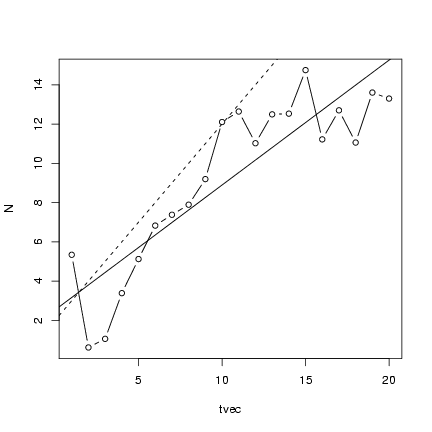
Plot the points along with the linear regression line
and the theoretical values:

<div class="p"><!----></div>
  <font color="#FF0000">
<pre>
&#62;&nbsp;plot(tvec,&nbsp;N,&nbsp;type&nbsp;=&nbsp;"b")
&#62;&nbsp;abline(lm1)
&#62;&nbsp;abline(a&nbsp;=&nbsp;2,&nbsp;b&nbsp;=&nbsp;1,&nbsp;lty&nbsp;=&nbsp;2)
&nbsp;
</pre> </font>

<div class="p"><!----></div>
<img src="lab5-035.png" alt="lab5-035.png" />

<div class="p"><!----></div>
Running experiments with many linear simulations:

<div class="p"><!----></div>
  <font color="#FF0000">
<pre>
&#62;&nbsp;nsim&nbsp;=&nbsp;100
&#62;&nbsp;Nmat&nbsp;=&nbsp;matrix(nrow&nbsp;=&nbsp;20,&nbsp;ncol&nbsp;=&nbsp;100)
&#62;&nbsp;for&nbsp;(i&nbsp;in&nbsp;1:nsim)&nbsp;{
+&nbsp;&nbsp;&nbsp;&nbsp;&nbsp;Nmat[,&nbsp;i]&nbsp;=&nbsp;linsim()
+&nbsp;}
&nbsp;
</pre> </font>

<div class="p"><!----></div>
Find the 2.5% quantile:

<div class="p"><!----></div>
  <font color="#FF0000">
<pre>
&#62;&nbsp;lower&nbsp;=&nbsp;apply(Nmat,&nbsp;1,&nbsp;quantile,&nbsp;0.025)
&nbsp;
</pre> </font>

<div class="p"><!----></div>
(You can find both the 2.5% and the 97.5% quantile
at the same time with
<tt>t(apply(Nmat,1,quantile,c(0.025,0.975)))</tt>.)

<div class="p"><!----></div>
<b>Exercise  6*</b>:
Using (among other functions) <tt>matplot()</tt>, 
<tt>rowMeans()</tt>,
<tt>quantile()</tt> (maybe <tt>matlines()</tt>):

<ul>
<li>run 1000 linear simulations with 

<math xmlns="http://www.w3.org/1998/Math/MathML">
<mrow>
<msub><mrow><mi>&sigma;</mi></mrow><mrow>
<mtext>obs</mtext>
</mrow>
</msub>
<mo>=</mo>
<msub><mrow><mi>&sigma;</mi></mrow><mrow>
<mtext>proc</mtext>
</mrow>
</msub>
<mo>=</mo><mn>2</mn></mrow></math>.
<div class="p"><!----></div>
</li>

<li>Plot all of the individual lines, in gray
<div class="p"><!----></div>
</li>

<li>Plot the mean at each time step, in black
<div class="p"><!----></div>
</li>

<li>Plot the 95% quantiles at each time step, black, with
dashed lines
<div class="p"><!----></div>
</li>
</ul>
Do the results match what you expect from the two extreme
cases (measurement error only/process error only) shown
in the chapter?

<div class="p"><!----></div>
      <h4><a name="tth_sEc3.1.2">
3.1.2</a>&nbsp;&nbsp;Sink population growth model</h4>
Here's another example, a model of
a sink population that
is maintained by immigration: the number
of individuals in the population surviving each year is
binomial, with a constant survival probability.
A Poisson-distributed number of immigrants arrives
every year, with a constant rate.

<div class="p"><!----></div>
   <font color="#FF0000">
<pre>
&#62;&nbsp;immigsim&nbsp;=&nbsp;function(nt&nbsp;=&nbsp;20,&nbsp;N0&nbsp;=&nbsp;2,&nbsp;immig,&nbsp;surv)&nbsp;{
+&nbsp;&nbsp;&nbsp;&nbsp;&nbsp;N&nbsp;=&nbsp;numeric(nt)
+&nbsp;&nbsp;&nbsp;&nbsp;&nbsp;N[1]&nbsp;=&nbsp;N0
+&nbsp;&nbsp;&nbsp;&nbsp;&nbsp;for&nbsp;(i&nbsp;in&nbsp;2:nt)&nbsp;{
+&nbsp;&nbsp;&nbsp;&nbsp;&nbsp;&nbsp;&nbsp;&nbsp;&nbsp;Nsurv&nbsp;=&nbsp;rbinom(1,&nbsp;size&nbsp;=&nbsp;N[i&nbsp;-&nbsp;1],&nbsp;prob&nbsp;=&nbsp;surv)
+&nbsp;&nbsp;&nbsp;&nbsp;&nbsp;&nbsp;&nbsp;&nbsp;&nbsp;N[i]&nbsp;=&nbsp;Nsurv&nbsp;+&nbsp;rpois(1,&nbsp;immig)
+&nbsp;&nbsp;&nbsp;&nbsp;&nbsp;}
+&nbsp;&nbsp;&nbsp;&nbsp;&nbsp;return(N)
+&nbsp;}
&nbsp;
</pre> </font>

<div class="p"><!----></div>
Running 1000 simulations:

<div class="p"><!----></div>
  <font color="#FF0000">
<pre>
&#62;&nbsp;nsim&nbsp;=&nbsp;1000
&#62;&nbsp;nt&nbsp;=&nbsp;30
&#62;&nbsp;p&nbsp;=&nbsp;0.95
&#62;&nbsp;N0&nbsp;=&nbsp;2
&#62;&nbsp;immig&nbsp;=&nbsp;10
&#62;&nbsp;Nmat&nbsp;=&nbsp;matrix(ncol&nbsp;=&nbsp;nsim,&nbsp;nrow&nbsp;=&nbsp;nt)
&#62;&nbsp;for&nbsp;(j&nbsp;in&nbsp;1:nsim)&nbsp;{
+&nbsp;&nbsp;&nbsp;&nbsp;&nbsp;Nmat[,&nbsp;j]&nbsp;=&nbsp;immigsim(nt&nbsp;=&nbsp;nt,&nbsp;N0&nbsp;=&nbsp;N0,&nbsp;surv&nbsp;=&nbsp;p,&nbsp;immig&nbsp;=&nbsp;immig)
+&nbsp;}
&#62;&nbsp;tvec&nbsp;=&nbsp;1:nt
&nbsp;
</pre> </font>

<div class="p"><!----></div>
It turns out that we can also derive the theoretical curve:

<math xmlns="http://www.w3.org/1998/Math/MathML">
<mrow><mi>E</mi><mo stretchy="false">[</mo>
<msub><mrow><mi>N</mi></mrow><mrow><mi>t</mi><mo>+</mo><mn>1</mn></mrow>
</msub>
<mo stretchy="false">]</mo><mo>=</mo><mi>p</mi>
<msub><mrow><mi>N</mi></mrow><mrow><mi>t</mi></mrow>
</msub>
<mo>+</mo><mi>I</mi></mrow></math>,
<br />
<table width="100%"><tr><td align="center">
    <math xmlns="http://www.w3.org/1998/Math/MathML">
    <mstyle displaystyle="true"><mrow>
<mtable align="right" width="80%">
<mtr><mtd columnalign="right" columnspan="1"><mrow><mi>N</mi><mo stretchy="false">(</mo><mi>t</mi><mo>+</mo><mn>1</mn><mo stretchy="false">)</mo></mrow>
</mtd><mtd columnalign="left">
<mrow><mo>=</mo></mrow>
</mtd><mtd columnalign="left">
<mrow><mi>pN</mi><mo stretchy="false">(</mo><mi>t</mi><mo stretchy="false">)</mo><mo>+</mo><mi>I</mi></mrow>
</mtd></mtr>
<mtr><mtd columnalign="right" columnspan="1"><mrow><mi>N</mi><mo stretchy="false">(</mo><mi>t</mi><mo>+</mo><mn>2</mn><mo stretchy="false">)</mo></mrow>
</mtd><mtd columnalign="left">
<mrow><mo>=</mo></mrow>
</mtd><mtd columnalign="left">
<mrow><mi>p</mi><mo stretchy="false">(</mo>
<msub><mrow><mi>pN</mi></mrow><mrow><mi>t</mi></mrow>
</msub>
<mo>+</mo><mi>I</mi><mo stretchy="false">)</mo><mo>+</mo><mi>I</mi><mo>=</mo>
<msup><mrow><mi>p</mi></mrow><mrow><mn>2</mn></mrow>
</msup>

<msub><mrow><mi>N</mi></mrow><mrow><mi>t</mi></mrow>
</msub>
<mo>+</mo><mi>pI</mi><mo>+</mo><mi>I</mi></mrow>
</mtd></mtr>
<mtr><mtd columnalign="right" columnspan="1"><mrow><mo>&#x2026;</mo></mrow>
</mtd><mtd columnalign="left">
<mrow></mrow>
</mtd><mtd columnalign="left">
<mrow></mrow>
</mtd></mtr>
</mtable>
</mrow>
    </mstyle></math>
</td></tr></table>
<br />

So in general, by induction,
<br />
<table width="100%"><tr><td align="center">
    <math xmlns="http://www.w3.org/1998/Math/MathML">
    <mstyle displaystyle="true"><mrow><mi>N</mi><mo stretchy="false">(</mo><mi>t</mi><mo>+</mo><mi>n</mi><mo stretchy="false">)</mo><mo>=</mo>
<msup><mrow><mi>p</mi></mrow><mrow><mi>n</mi></mrow>
</msup>

<msub><mrow><mi>N</mi></mrow><mrow><mi>t</mi></mrow>
</msub>
<mo>+</mo>
<munderover><mo>&sum;</mo><mrow><mi>j</mi><mo>=</mo><mn>0</mn> </mrow>
<mrow><mi>n</mi><mo>-</mo><mn>1</mn></mrow></munderover>
<msup><mrow><mi>p</mi></mrow><mrow><mi>j</mi></mrow>
</msup>
<mi>I</mi></mrow>
    </mstyle></math>
</td></tr></table>
<br />

or
<br />
<table width="100%"><tr><td align="center">
    <math xmlns="http://www.w3.org/1998/Math/MathML">
    <mstyle displaystyle="true"><mrow><mi>N</mi><mo stretchy="false">(</mo><mi>t</mi><mo stretchy="false">)</mo><mo>=</mo>
<msup><mrow><mi>p</mi></mrow><mrow><mi>t</mi><mo>-</mo><mn>1</mn></mrow>
</msup>

<msub><mrow><mi>N</mi></mrow><mrow><mn>1</mn></mrow>
</msub>
<mo>+</mo>
<mfrac><mrow><mn>1</mn><mo>-</mo>
<msup><mrow><mi>p</mi></mrow><mrow><mi>t</mi><mo>-</mo><mn>1</mn></mrow>
</msup>
</mrow>
<mrow><mn>1</mn><mo>-</mo><mi>p</mi></mrow>
</mfrac>
<mi>I</mi></mrow>
    </mstyle></math>
</td></tr></table>
<br />

(accounting for the fact that we start at 
<math xmlns="http://www.w3.org/1998/Math/MathML">
<mrow><mi>t</mi><mo>=</mo><mn>1</mn></mrow></math>
and using the formula for the sum of a geometric series,

<math xmlns="http://www.w3.org/1998/Math/MathML">
<mrow>
<munderover><mo>&sum;</mo><mrow><mi>j</mi><mo>=</mo><mn>0</mn> </mrow>
<mrow><mi>n</mi><mo>-</mo><mn>1</mn></mrow></munderover>
<msup><mrow><mi>p</mi></mrow><mrow><mi>j</mi></mrow>
</msup>
<mo>=</mo><mo stretchy="false">(</mo><mn>1</mn><mo>-</mo>
<msup><mrow><mi>p</mi></mrow><mrow><mi>t</mi><mo>-</mo><mn>1</mn></mrow>
</msup>
<mo stretchy="false">)</mo><mo stretchy="false">/</mo><mo stretchy="false">(</mo><mn>1</mn><mo>-</mo><mi>p</mi><mo stretchy="false">)</mo></mrow></math>).

<div class="p"><!----></div>
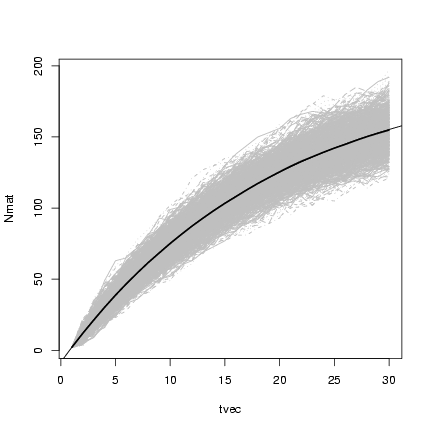
Plotting 
<math xmlns="http://www.w3.org/1998/Math/MathML">
<mrow><mi>x</mi></mrow></math>
and superimposing
lines showing the mean value of the simulations:

<div class="p"><!----></div>
  <font color="#FF0000">
<pre>
&#62;&nbsp;matplot(tvec,&nbsp;Nmat,&nbsp;type&nbsp;=&nbsp;"l",&nbsp;col&nbsp;=&nbsp;"gray")
&#62;&nbsp;lines(tvec,&nbsp;rowMeans(Nmat),&nbsp;lwd&nbsp;=&nbsp;2)
&#62;&nbsp;curve(p^(x&nbsp;-&nbsp;1)&nbsp;*&nbsp;N0&nbsp;+&nbsp;(1&nbsp;-&nbsp;p^(x&nbsp;-&nbsp;1))/(1&nbsp;-&nbsp;p)&nbsp;*&nbsp;immig,&nbsp;add&nbsp;=&nbsp;TRUE)
&nbsp;
</pre> </font>

<div class="p"><!----></div>
<img src="lab5-041.png" alt="lab5-041.png" />

<div class="p"><!----></div>
     <h3><a name="tth_sEc3.2">
3.2</a>&nbsp;&nbsp;Continuous time</h3>

<div class="p"><!----></div>
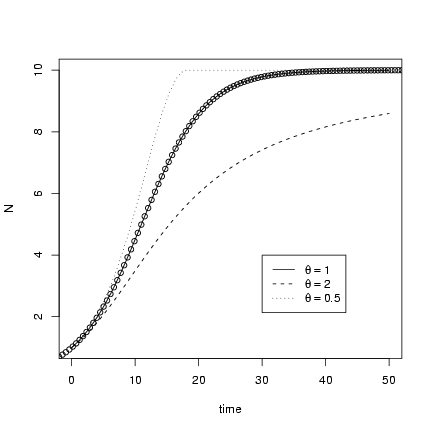
Solving the theta-logistic model,
<br />
<table width="100%"><tr><td align="center">
    <math xmlns="http://www.w3.org/1998/Math/MathML">
    <mstyle displaystyle="true"><mrow>
<mfrac><mrow><mi>dN</mi></mrow>
<mrow><mi>dt</mi></mrow>
</mfrac>
<mo>=</mo><mi>rN</mi>
<msup><mrow><mo>(</mo><mn>1</mn><mo>-</mo>
<mfrac><mrow><mi>N</mi></mrow>
<mrow><mi>K</mi></mrow>
</mfrac>
<mo>)</mo></mrow><mrow><mi>&theta;</mi></mrow>
</msup>
</mrow>
    </mstyle></math>
</td></tr></table>
<br />

numerically:

<div class="p"><!----></div>
Attach <tt>odesolve</tt> package:

<div class="p"><!----></div>
  <font color="#FF0000">
<pre>
&#62;&nbsp;library(odesolve)
&nbsp;
</pre> </font>

<div class="p"><!----></div>
Define a function for the derivative.  It <em>must</em>
have arguments (time, state vector, parameters), although
they need not be called  <tt>t</tt>, <tt>y</tt>, <tt>params</tt>. 
The only other peculiarity is that instead of returning
the derivative (<tt>dNdt</tt> in this case) 
by itself you actually have to return a list
containing the derivative as its first element and
"a vector of global values that are required at each point"
(which can usually be <tt>NULL</tt>).

<div class="p"><!----></div>
  <font color="#FF0000">
<pre>
&#62;&nbsp;derivfun&nbsp;=&nbsp;function(t,&nbsp;y,&nbsp;parms)&nbsp;{
+&nbsp;&nbsp;&nbsp;&nbsp;&nbsp;r&nbsp;=&nbsp;parms[1]
+&nbsp;&nbsp;&nbsp;&nbsp;&nbsp;K&nbsp;=&nbsp;parms[2]
+&nbsp;&nbsp;&nbsp;&nbsp;&nbsp;theta&nbsp;=&nbsp;parms[3]
+&nbsp;&nbsp;&nbsp;&nbsp;&nbsp;N&nbsp;=&nbsp;y[1]
+&nbsp;&nbsp;&nbsp;&nbsp;&nbsp;dNdt&nbsp;=&nbsp;r&nbsp;*&nbsp;N&nbsp;*&nbsp;sign(1&nbsp;-&nbsp;N/K)&nbsp;*&nbsp;abs((1&nbsp;-&nbsp;N/K))^theta
+&nbsp;&nbsp;&nbsp;&nbsp;&nbsp;list(dNdt,&nbsp;NULL)
+&nbsp;}
&nbsp;
</pre> </font>

<div class="p"><!----></div>
Once you've defined the derivative function, you can 
use the <tt>lsoda</tt> function to solve
that differential equation for any set of 
starting values (<tt>y</tt>), 
times (<tt>times</tt>), and parameters (<tt>parms</tt>)
you like.

<div class="p"><!----></div>
   <font color="#FF0000">
<pre>
&#62;&nbsp;tvec&nbsp;=&nbsp;seq(0,&nbsp;50,&nbsp;by&nbsp;=&nbsp;0.2)
&#62;&nbsp;x1&nbsp;=&nbsp;lsoda(y&nbsp;=&nbsp;c(N&nbsp;=&nbsp;1),&nbsp;times&nbsp;=&nbsp;tvec,&nbsp;func&nbsp;=&nbsp;derivfun,&nbsp;parms&nbsp;=&nbsp;c(r&nbsp;=&nbsp;0.2,&nbsp;
+&nbsp;&nbsp;&nbsp;&nbsp;&nbsp;K&nbsp;=&nbsp;10,&nbsp;theta&nbsp;=&nbsp;1))
&nbsp;
</pre> </font>

<div class="p"><!----></div>
You get back a numeric matrix with a column for
the times and columns for all of the state variables
(only one in this case):

<div class="p"><!----></div>
  <font color="#FF0000">
<pre>
&#62;&nbsp;head(x1)
&nbsp;
</pre> </font>
  <font color="#0000FF">
<pre>
&nbsp;&nbsp;&nbsp;&nbsp;&nbsp;time&nbsp;&nbsp;&nbsp;&nbsp;&nbsp;&nbsp;&nbsp;&nbsp;N
[1,]&nbsp;&nbsp;0.0&nbsp;1.000000
[2,]&nbsp;&nbsp;0.2&nbsp;1.036581
[3,]&nbsp;&nbsp;0.4&nbsp;1.074341
[4,]&nbsp;&nbsp;0.6&nbsp;1.113303
[5,]&nbsp;&nbsp;0.8&nbsp;1.153495
[6,]&nbsp;&nbsp;1.0&nbsp;1.194945

&nbsp;
</pre> </font>

<div class="p"><!----></div>
Re-running the solution for different values of 
<math xmlns="http://www.w3.org/1998/Math/MathML">
<mrow><mi>&theta;</mi></mrow></math>:

<div class="p"><!----></div>
  <font color="#FF0000">
<pre>
&#62;&nbsp;x2&nbsp;=&nbsp;lsoda(y&nbsp;=&nbsp;c(N&nbsp;=&nbsp;1),&nbsp;times&nbsp;=&nbsp;tvec,&nbsp;func&nbsp;=&nbsp;derivfun,&nbsp;parms&nbsp;=&nbsp;c(r&nbsp;=&nbsp;0.2,&nbsp;
+&nbsp;&nbsp;&nbsp;&nbsp;&nbsp;K&nbsp;=&nbsp;10,&nbsp;theta&nbsp;=&nbsp;2))
&#62;&nbsp;x3&nbsp;=&nbsp;lsoda(y&nbsp;=&nbsp;c(N&nbsp;=&nbsp;1),&nbsp;times&nbsp;=&nbsp;tvec,&nbsp;func&nbsp;=&nbsp;derivfun,&nbsp;parms&nbsp;=&nbsp;c(r&nbsp;=&nbsp;0.2,&nbsp;
+&nbsp;&nbsp;&nbsp;&nbsp;&nbsp;K&nbsp;=&nbsp;10,&nbsp;theta&nbsp;=&nbsp;0.5))
&nbsp;
</pre> </font>

<div class="p"><!----></div>
Putting the results together into a single matrix
(both columns of the first matrix and only the
second column of the other two):

<div class="p"><!----></div>
  <font color="#FF0000">
<pre>
&#62;&nbsp;X&nbsp;=&nbsp;cbind(x1,&nbsp;x2[,&nbsp;"N"],&nbsp;x3[,&nbsp;"N"])
&nbsp;
</pre> </font>

<div class="p"><!----></div>
Plotting with <tt>matplot()</tt>,
and using <tt>curve</tt> and the known
solution for the plain old logistic
to check the solution when 
<math xmlns="http://www.w3.org/1998/Math/MathML">
<mrow><mi>&theta;</mi><mo>=</mo><mn>1</mn></mrow></math>:

<div class="p"><!----></div>
  <font color="#FF0000">
<pre>
&#62;&nbsp;matplot(X[,&nbsp;"time"],&nbsp;X[,&nbsp;2:4],&nbsp;type&nbsp;=&nbsp;"l",&nbsp;col&nbsp;=&nbsp;1,&nbsp;xlab&nbsp;=&nbsp;"time",&nbsp;
+&nbsp;&nbsp;&nbsp;&nbsp;&nbsp;ylab&nbsp;=&nbsp;"N")
&#62;&nbsp;r&nbsp;=&nbsp;0.2
&#62;&nbsp;K&nbsp;=&nbsp;10
&#62;&nbsp;N0&nbsp;=&nbsp;1
&#62;&nbsp;curve(K/((1&nbsp;+&nbsp;(K/N0&nbsp;-&nbsp;1)&nbsp;*&nbsp;exp(-r&nbsp;*&nbsp;x))),&nbsp;type&nbsp;=&nbsp;"p",&nbsp;add&nbsp;=&nbsp;TRUE)
&#62;&nbsp;legend(30,&nbsp;4,&nbsp;c(expression(theta&nbsp;==&nbsp;1),&nbsp;expression(theta&nbsp;==&nbsp;2),&nbsp;
+&nbsp;&nbsp;&nbsp;&nbsp;&nbsp;expression(theta&nbsp;==&nbsp;0.5)),&nbsp;lty&nbsp;=&nbsp;1:3)
&nbsp;
</pre> </font>

<div class="p"><!----></div>
<img src="lab5-048.png" alt="lab5-048.png" />

<div class="p"><!----></div>
(remember you have to use <tt>==</tt> to
get an equals sign in a
math expression).

<div class="p"><!----></div>
 <h2><a name="tth_sEc4">
4</a>&nbsp;&nbsp;Power etc. calculations</h2>

<div class="p"><!----></div>
This section will first go through a relatively
simple example (the source-sink population model
presented above), showing the basic steps of a
power calculation.  I'll then give a briefer sketch
of some of the gory details of doing the Shepherd model
power analysis discussed in the chapter.

<div class="p"><!----></div>
     <h3><a name="tth_sEc4.1">
4.1</a>&nbsp;&nbsp;Sink population dynamics</h3>

<div class="p"><!----></div>
The sink population presented above was a recovering
sink population: the biological question I will
try to answer is: how long do I have to sample the
population for to test that it is really recovering?
How does this depend on the survival and immigration
rates?

<div class="p"><!----></div>
First, simulate one set of values and a time vector:

<div class="p"><!----></div>
  <font color="#FF0000">
<pre>
&#62;&nbsp;nt&nbsp;=&nbsp;20
&#62;&nbsp;sim0&nbsp;=&nbsp;immigsim(nt&nbsp;=&nbsp;nt,&nbsp;N0&nbsp;=&nbsp;2,&nbsp;surv&nbsp;=&nbsp;0.9,&nbsp;immig&nbsp;=&nbsp;10)
&#62;&nbsp;tvec&nbsp;=&nbsp;1:nt
&nbsp;
</pre> </font>

<div class="p"><!----></div>
Run a linear regression and extract the
point estimate
and confidence limits
for the slope:

<div class="p"><!----></div>
  <font color="#FF0000">
<pre>
&#62;&nbsp;lm1&nbsp;=&nbsp;lm(sim0&nbsp;~&nbsp;tvec)
&#62;&nbsp;slope&nbsp;=&nbsp;coef(lm1)["tvec"]
&#62;&nbsp;ci.slope&nbsp;=&nbsp;confint(lm1)["tvec",&nbsp;]
&nbsp;
</pre> </font>

<div class="p"><!----></div>
(look at the output of <tt>confint(lm1)</tt> to see how it's structured).

<div class="p"><!----></div>
Now run the model for a series of lengths of observation time
and record the values for each length:

<div class="p"><!----></div>
  <font color="#FF0000">
<pre>
&#62;&nbsp;nvec&nbsp;=&nbsp;c(3,&nbsp;5,&nbsp;7,&nbsp;10,&nbsp;15,&nbsp;20)
&#62;&nbsp;nsim&nbsp;=&nbsp;500
&#62;&nbsp;powsimresults&nbsp;=&nbsp;matrix(nrow&nbsp;=&nbsp;length(nvec)&nbsp;*&nbsp;nsim,&nbsp;ncol&nbsp;=&nbsp;5)
&#62;&nbsp;colnames(powsimresults)&nbsp;=&nbsp;c("n",&nbsp;"sim",&nbsp;"slope",&nbsp;"slope.lo",&nbsp;
+&nbsp;&nbsp;&nbsp;&nbsp;&nbsp;"slope.hi")
&#62;&nbsp;ctr&nbsp;=&nbsp;1
&#62;&nbsp;for&nbsp;(i&nbsp;in&nbsp;1:length(nvec))&nbsp;{
+&nbsp;&nbsp;&nbsp;&nbsp;&nbsp;nt&nbsp;=&nbsp;nvec[i]
+&nbsp;&nbsp;&nbsp;&nbsp;&nbsp;tvec&nbsp;=&nbsp;1:nt
+&nbsp;&nbsp;&nbsp;&nbsp;&nbsp;cat(nt,&nbsp;"\n")
+&nbsp;&nbsp;&nbsp;&nbsp;&nbsp;for&nbsp;(sim&nbsp;in&nbsp;1:nsim)&nbsp;{
+&nbsp;&nbsp;&nbsp;&nbsp;&nbsp;&nbsp;&nbsp;&nbsp;&nbsp;current.sim&nbsp;=&nbsp;immigsim(nt&nbsp;=&nbsp;nt,&nbsp;N0&nbsp;=&nbsp;N0,&nbsp;surv&nbsp;=&nbsp;p,&nbsp;immig&nbsp;=&nbsp;immig)
+&nbsp;&nbsp;&nbsp;&nbsp;&nbsp;&nbsp;&nbsp;&nbsp;&nbsp;lm1&nbsp;=&nbsp;lm(current.sim&nbsp;~&nbsp;tvec)
+&nbsp;&nbsp;&nbsp;&nbsp;&nbsp;&nbsp;&nbsp;&nbsp;&nbsp;slope&nbsp;=&nbsp;coef(lm1)["tvec"]
+&nbsp;&nbsp;&nbsp;&nbsp;&nbsp;&nbsp;&nbsp;&nbsp;&nbsp;ci.slope&nbsp;=&nbsp;confint(lm1)["tvec",&nbsp;]
+&nbsp;&nbsp;&nbsp;&nbsp;&nbsp;&nbsp;&nbsp;&nbsp;&nbsp;powsimresults[ctr,&nbsp;]&nbsp;=&nbsp;c(nt,&nbsp;sim,&nbsp;slope,&nbsp;ci.slope)
+&nbsp;&nbsp;&nbsp;&nbsp;&nbsp;&nbsp;&nbsp;&nbsp;&nbsp;ctr&nbsp;=&nbsp;ctr&nbsp;+&nbsp;1
+&nbsp;&nbsp;&nbsp;&nbsp;&nbsp;}
+&nbsp;}
&nbsp;
</pre> </font>
  <font color="#0000FF">
<pre>
3&nbsp;
5&nbsp;
7&nbsp;
10&nbsp;
15&nbsp;
20&nbsp;

&nbsp;
</pre> </font>

<div class="p"><!----></div>
A couple of  R&nbsp;tricks in this code:

<ul>
<li>I'm going to keep the output in long format, with
each row containing the sample size and simulation number
along with the estimate and confidence intervals:
this will make it easy to cross-tabulate the results
(see below)
<div class="p"><!----></div>
</li>

<li>I keep a counter variable <tt>ctr</tt> to track
which row of the matrix I'm filling in, and add
one to it each time through the loop. (Alternately
I could calculate that at the <tt>i</tt>
<math xmlns="http://www.w3.org/1998/Math/MathML">
<mrow>
<msup><mrow></mrow><mrow><mi>t</mi></mrow>
</msup>
<mi>h</mi></mrow></math> sample size 
and <tt>s</tt>
<math xmlns="http://www.w3.org/1998/Math/MathML">
<mrow>
<msup><mrow></mrow><mrow><mi>t</mi></mrow>
</msup>
<mi>h</mi></mrow></math> simulation I should be filling in
row <tt>(i-1)*nsim+i</tt>.)
Make sure to reset <tt>ctr</tt> if you re-run the
<tt>for</tt> loops.
<div class="p"><!----></div>
</li>

<li>the <tt>cat()</tt> command is just printing results
as I go along: on Windows you may have to go to a menu
and unselect the "buffered output" option.  The
<tt>"\n"</tt> at the end specifies a new line.
<div class="p"><!----></div>
</li>

<li>I keep track of simulation number in the loop
but the <em>index</em> of the sample size:
<tt>i</tt> is (1, 2, 3, ...) rather
than <tt>i</tt> (3, 5, 7, ...). This isn't
totally necessary in this case since we're using
<tt>ctr</tt> to index the rows of the matrix, but it's
generally safer.
<div class="p"><!----></div>
</li>
</ul>

<div class="p"><!----></div>
Now summarize the results, cross-tabulating
by the number of samples.

<div class="p"><!----></div>
  <font color="#FF0000">
<pre>
&#62;&nbsp;nfac&nbsp;=&nbsp;factor(powsimresults[,&nbsp;"n"])
&nbsp;
</pre> </font>

<div class="p"><!----></div>
Select the point estimate and calculate its mean
(
<math xmlns="http://www.w3.org/1998/Math/MathML">
<mrow><mi>E</mi><mo stretchy="false">[</mo>
<mover><mrow><mi>s</mi></mrow>
<mo>&Hat;</mo></mover>
<mo stretchy="false">]</mo></mrow></math>)
for each observation length:

<div class="p"><!----></div>
  <font color="#FF0000">
<pre>
&#62;&nbsp;slope.mean&nbsp;=&nbsp;tapply(powsimresults[,&nbsp;"slope"],&nbsp;nfac,&nbsp;mean)
&nbsp;
</pre> </font>

<div class="p"><!----></div>
Calculate the standard deviation:

<div class="p"><!----></div>
  <font color="#FF0000">
<pre>
&#62;&nbsp;slope.sd&nbsp;=&nbsp;tapply(powsimresults[,&nbsp;"slope"],&nbsp;nfac,&nbsp;sd)
&nbsp;
</pre> </font>

<div class="p"><!----></div>
to calculate the variance of the estimate.

<div class="p"><!----></div>
Calculating whether the true value fell within
the confidence limits in a particular simulation.
(The theoretical value of the slope is a little
hard here since the expected value of the population
is actually to grow to an asymptote.  Near the
beginning the slope is close to the immigration
rate:

<div class="p"><!----></div>
  <font color="#FF0000">
<pre>
&#62;&nbsp;ci.good&nbsp;=&nbsp;(powsimresults[,&nbsp;"slope.hi"]&nbsp;&#62;&nbsp;immig)&nbsp;&amp;&nbsp;(powsimresults[,&nbsp;
+&nbsp;&nbsp;&nbsp;&nbsp;&nbsp;"slope.lo"]&nbsp;&lt;&nbsp;immig)
&nbsp;
</pre> </font>

<div class="p"><!----></div>
Calculating the coverage by cross-tabulating the number of "good" confidence
intervals and dividing by the number of simulations per 
<math xmlns="http://www.w3.org/1998/Math/MathML">
<mrow><mi>d</mi></mrow></math>/sample size combination:

<div class="p"><!----></div>
  <font color="#FF0000">
<pre>
&#62;&nbsp;nsim&nbsp;=&nbsp;500
&#62;&nbsp;slope.cov&nbsp;=&nbsp;tapply(ci.good,&nbsp;nfac,&nbsp;sum)/nsim
&nbsp;
</pre> </font>

<div class="p"><!----></div>
(so the "coverage" actually decreases in this case,
but this is a bad example - sorry!)

<div class="p"><!----></div>
Calculating whether the null value (zero) <em>did not</em>
fall within the confidence limits:

<div class="p"><!----></div>
  <font color="#FF0000">
<pre>
&#62;&nbsp;null.value&nbsp;=&nbsp;0
&#62;&nbsp;reject.null&nbsp;=&nbsp;(powsimresults[,&nbsp;"slope.hi"]&nbsp;&lt;&nbsp;null.value)&nbsp;|&nbsp;(powsimresults[,&nbsp;
+&nbsp;&nbsp;&nbsp;&nbsp;&nbsp;"slope.lo"]&nbsp;&#62;&nbsp;null.value)
&nbsp;
</pre> </font>

<div class="p"><!----></div>
Calculating the power by cross-tabulating the number of rejections
of the null hypothesis  and dividing by the number of simulations per 
<math xmlns="http://www.w3.org/1998/Math/MathML">
<mrow><mi>d</mi></mrow></math>/sample size combination:

<div class="p"><!----></div>
  <font color="#FF0000">
<pre>
&#62;&nbsp;slope.pow&nbsp;=&nbsp;tapply(reject.null,&nbsp;nfac,&nbsp;sum)/nsim
&nbsp;
</pre> </font>

<div class="p"><!----></div>
In this case it's very easy to see, very quickly, that
the population is recovering ...

<div class="p"><!----></div>
<b>Exercise  7*</b>: redo this example, but with negative
binomial growth (with 
<math xmlns="http://www.w3.org/1998/Math/MathML">
<mrow><mi>k</mi><mo>=</mo><mn>5</mn></mrow></math>, 
<math xmlns="http://www.w3.org/1998/Math/MathML">
<mrow><mi>k</mi><mo>=</mo><mn>1</mn></mrow></math>, and 
<math xmlns="http://www.w3.org/1998/Math/MathML">
<mrow><mi>k</mi><mo>=</mo><mn>0</mn><mo>.</mo><mn>5</mn></mrow></math>).  If you want
to be fancy, try to nest an additional <tt>for</tt> loop and
cross-tabulate your answers with a single command (see code
below under reef fish example): otherwise simply change
the variable and re-run the code three times. <br />
<font size="+1"><b>or</b></font> <br />
<b>Exercise  8**</b>: in  R, you
can fit a quadratic function with

<div class="p"><!----></div>
  <font color="#FF0000">
<pre>
&#62;&nbsp;lm.q&nbsp;=&nbsp;lm(sim0&nbsp;~&nbsp;tvec&nbsp;+&nbsp;I(tvec^2))
&nbsp;
</pre> </font>

<div class="p"><!----></div>
Extract the point estimate
for the quadratic term
with <tt>coef(lm.q)[3]</tt> and
the confidence intervals with
<tt>confint(lm.q)[3,]</tt>.
For the original model (with Poisson variability),
do a power analysis of your ability to
detect the leveling-off of the
curve (as a negative
quadratic term in the regression fit)
as a function of number of observation
periods.  (If you're really ambitious,
combine the two problems and
try this with negative binomial variation.)

<div class="p"><!----></div>
     <h3><a name="tth_sEc4.2">
4.2</a>&nbsp;&nbsp;Reef fish dynamics</h3>

<div class="p"><!----></div>
Regenerating a simulated version of Schmitt et al. data.

<div class="p"><!----></div>
(Re)define zero-inflated negative binomial and Shepherd functions:

<div class="p"><!----></div>
  <font color="#FF0000">
<pre>
&#62;&nbsp;rzinbinom&nbsp;=&nbsp;function(n,&nbsp;mu,&nbsp;size,&nbsp;zprob)&nbsp;{
+&nbsp;&nbsp;&nbsp;&nbsp;&nbsp;ifelse(runif(n)&nbsp;&lt;&nbsp;zprob,&nbsp;0,&nbsp;rnbinom(n,&nbsp;mu&nbsp;=&nbsp;mu,&nbsp;size&nbsp;=&nbsp;size))
+&nbsp;}
&#62;&nbsp;shep&nbsp;=&nbsp;function(x,&nbsp;a&nbsp;=&nbsp;0.696,&nbsp;b&nbsp;=&nbsp;9.79,&nbsp;d&nbsp;=&nbsp;1)&nbsp;{
+&nbsp;&nbsp;&nbsp;&nbsp;&nbsp;a/(1&nbsp;+&nbsp;(a/b)&nbsp;*&nbsp;x^d)
+&nbsp;}
&nbsp;
</pre> </font>

<div class="p"><!----></div>
Parameters for distribution of settlers
(
<math xmlns="http://www.w3.org/1998/Math/MathML">
<mrow><mi>&mu;</mi></mrow></math>, 
<math xmlns="http://www.w3.org/1998/Math/MathML">
<mrow><mi>k</mi></mrow></math>, 
<math xmlns="http://www.w3.org/1998/Math/MathML">
<mrow>
<msub><mrow><mi>p</mi></mrow><mrow><mi>z</mi></mrow>
</msub>
</mrow></math>) and
Shepherd function (
<math xmlns="http://www.w3.org/1998/Math/MathML">
<mrow><mi>a</mi></mrow></math>, 
<math xmlns="http://www.w3.org/1998/Math/MathML">
<mrow><mi>b</mi></mrow></math>, 
<math xmlns="http://www.w3.org/1998/Math/MathML">
<mrow><mi>d</mi></mrow></math>):

<div class="p"><!----></div>
  <font color="#FF0000">
<pre>
&#62;&nbsp;mu&nbsp;=&nbsp;25.32
&#62;&nbsp;k&nbsp;=&nbsp;0.932
&#62;&nbsp;zprob&nbsp;=&nbsp;0.123
&#62;&nbsp;a&nbsp;=&nbsp;0.696
&#62;&nbsp;b&nbsp;=&nbsp;9.79
&#62;&nbsp;d&nbsp;=&nbsp;1.1
&#62;&nbsp;n&nbsp;=&nbsp;603
&nbsp;
</pre> </font>

<div class="p"><!----></div>
Simulate one set of values:

<div class="p"><!----></div>
  <font color="#FF0000">
<pre>
&#62;&nbsp;set.seed(1002)
&#62;&nbsp;settlers&nbsp;=&nbsp;rzinbinom(n,&nbsp;mu&nbsp;=&nbsp;mu,&nbsp;size&nbsp;=&nbsp;k,&nbsp;zprob&nbsp;=&nbsp;zprob)
&#62;&nbsp;recr&nbsp;=&nbsp;rbinom(n,&nbsp;prob&nbsp;=&nbsp;shep(settlers,&nbsp;a,&nbsp;b,&nbsp;d),&nbsp;size&nbsp;=&nbsp;settlers)
&nbsp;
</pre> </font>

<div class="p"><!----></div>
The nonlinear least-squares function <tt>nls()</tt> takes
a formula and a named set of starting values.
Start by fitting the Beverton-Holt, which is easier
to fit than the Shepherd.
(This is a typical way to fit a complex model: start with
a simpler, easier-to-fit model that is a special case of the complex model,
then use those fitted parameters as a starting point
for the harder estimation problem.)
Use the theoretical
values of 
<math xmlns="http://www.w3.org/1998/Math/MathML">
<mrow><mi>a</mi></mrow></math> and 
<math xmlns="http://www.w3.org/1998/Math/MathML">
<mrow><mi>b</mi></mrow></math> as starting parameters
for the Beverton-Holt fit:

<div class="p"><!----></div>
   <font color="#FF0000">
<pre>
&#62;&nbsp;bh.fit&nbsp;=&nbsp;nls(recr&nbsp;~&nbsp;a&nbsp;*&nbsp;settlers/(1&nbsp;+&nbsp;(a/b)&nbsp;*&nbsp;settlers),&nbsp;start&nbsp;=&nbsp;c(a&nbsp;=&nbsp;0.696,&nbsp;
+&nbsp;&nbsp;&nbsp;&nbsp;&nbsp;b&nbsp;=&nbsp;9.79))
&#62;&nbsp;bh.fit
&nbsp;
</pre> </font>
  <font color="#0000FF">
<pre>
Nonlinear&nbsp;regression&nbsp;model
&nbsp;&nbsp;model:&nbsp;&nbsp;recr&nbsp;~&nbsp;a&nbsp;*&nbsp;settlers/(1&nbsp;+&nbsp;(a/b)&nbsp;*&nbsp;settlers)&nbsp;
&nbsp;&nbsp;&nbsp;data:&nbsp;&nbsp;parent.frame()&nbsp;
&nbsp;&nbsp;&nbsp;&nbsp;&nbsp;&nbsp;&nbsp;&nbsp;a&nbsp;&nbsp;&nbsp;&nbsp;&nbsp;&nbsp;&nbsp;&nbsp;&nbsp;b&nbsp;
0.7775758&nbsp;6.6934193&nbsp;
&nbsp;residual&nbsp;sum-of-squares:&nbsp;&nbsp;1639.527&nbsp;

&nbsp;
</pre> </font>

<div class="p"><!----></div>
The function <tt>coef(bh)</tt> gives the fitted parameters
(coefficients).  Use these, plus a starting value of 
<math xmlns="http://www.w3.org/1998/Math/MathML">
<mrow><mi>d</mi><mo>=</mo><mn>1</mn></mrow></math>,
to fit the Shepherd function.

<div class="p"><!----></div>
   <font color="#FF0000">
<pre>
&#62;&nbsp;shep.fit&nbsp;=&nbsp;nls(recr&nbsp;~&nbsp;a&nbsp;*&nbsp;settlers/(1&nbsp;+&nbsp;(a/b)&nbsp;*&nbsp;settlers^d),&nbsp;
+&nbsp;&nbsp;&nbsp;&nbsp;&nbsp;start&nbsp;=&nbsp;c(coef(bh.fit),&nbsp;d&nbsp;=&nbsp;1))
&#62;&nbsp;shep.fit
&nbsp;
</pre> </font>
  <font color="#0000FF">
<pre>
Nonlinear&nbsp;regression&nbsp;model
&nbsp;&nbsp;model:&nbsp;&nbsp;recr&nbsp;~&nbsp;a&nbsp;*&nbsp;settlers/(1&nbsp;+&nbsp;(a/b)&nbsp;*&nbsp;settlers^d)&nbsp;
&nbsp;&nbsp;&nbsp;data:&nbsp;&nbsp;parent.frame()&nbsp;
&nbsp;&nbsp;&nbsp;&nbsp;&nbsp;&nbsp;&nbsp;&nbsp;&nbsp;a&nbsp;&nbsp;&nbsp;&nbsp;&nbsp;&nbsp;&nbsp;&nbsp;&nbsp;&nbsp;b&nbsp;&nbsp;&nbsp;&nbsp;&nbsp;&nbsp;&nbsp;&nbsp;&nbsp;&nbsp;d&nbsp;
&nbsp;0.5998674&nbsp;12.0196853&nbsp;&nbsp;1.1362227&nbsp;
&nbsp;residual&nbsp;sum-of-squares:&nbsp;&nbsp;1631.212&nbsp;

&nbsp;
</pre> </font>

<div class="p"><!----></div>
Calculate confidence intervals:

<div class="p"><!----></div>
  <font color="#FF0000">
<pre>
&#62;&nbsp;ci&nbsp;=&nbsp;confint(shep.fit)
&nbsp;
</pre> </font>
  <font color="#0000FF">
<pre>
Waiting&nbsp;for&nbsp;profiling&nbsp;to&nbsp;be&nbsp;done...

&nbsp;
</pre> </font>
  <font color="#FF0000">
<pre>
&#62;&nbsp;ci
&nbsp;
</pre> </font>
  <font color="#0000FF">
<pre>
&nbsp;&nbsp;&nbsp;&nbsp;&nbsp;&nbsp;&nbsp;2.5%&nbsp;&nbsp;&nbsp;&nbsp;&nbsp;&nbsp;97.5%
a&nbsp;0.4630841&nbsp;&nbsp;0.8419771
b&nbsp;6.2920786&nbsp;26.0900580
d&nbsp;0.9846074&nbsp;&nbsp;1.3152524

&nbsp;
</pre> </font>

<div class="p"><!----></div>
Extract the estimates for 
<math xmlns="http://www.w3.org/1998/Math/MathML">
<mrow><mi>d</mi></mrow></math>:

<div class="p"><!----></div>
  <font color="#FF0000">
<pre>
&#62;&nbsp;ci["d",&nbsp;]
&nbsp;
</pre> </font>
  <font color="#0000FF">
<pre>
&nbsp;&nbsp;&nbsp;&nbsp;&nbsp;2.5%&nbsp;&nbsp;&nbsp;&nbsp;&nbsp;97.5%&nbsp;
0.9846074&nbsp;1.3152524&nbsp;

&nbsp;
</pre> </font>

<div class="p"><!----></div>
Sometimes the confidence interval fitting runs into trouble
and stops with an error like

<pre>
Error&nbsp;in&nbsp;prof$getProfile()&nbsp;:&nbsp;step&nbsp;factor&nbsp;0.000488281&nbsp;reduced&nbsp;
&nbsp;&nbsp;&nbsp;&nbsp;below&nbsp;'minFactor'&nbsp;of&nbsp;0.000976562

</pre>

<div class="p"><!----></div>
This kind of glitch is fairly rare when doing analyses one at a time,
but very common when doing power analyses, which require thousands
or tens of thousands of fits.  A few  R&nbsp;tricks for dealing with this:

<ul>
<li><tt>x = try(command)</tt> "tries" a command to see if it works or not;
it it doesn't work,  Rdoesn't stop but sets <tt>x</tt> equal to the
error message. To test whether the command stopped or not, see if
<tt>class(x)=="try-error"</tt>

<div class="p"><!----></div>
</li>

<li><tt>while</tt> and <tt>if</tt> are commands for flow control
(like the <tt>for()</tt> command introduced earlier in this lab):
<tt>if</tt> executes a set of commands (once) if some condition
is true, and 
<tt>while</tt> loops and executes a set of commands <em>as long as</em> some condition
is true

<div class="p"><!----></div>
</li>
</ul>

<div class="p"><!----></div>
The code below is a slightly simplified version of what I did
to generate the values

<div class="p"><!----></div>
  <font color="#FF0000">
<pre>
&#62;&nbsp;getvals&nbsp;=&nbsp;function(n&nbsp;=&nbsp;100,&nbsp;d&nbsp;=&nbsp;1)&nbsp;{
+&nbsp;&nbsp;&nbsp;&nbsp;&nbsp;OK&nbsp;=&nbsp;FALSE
+&nbsp;&nbsp;&nbsp;&nbsp;&nbsp;while&nbsp;(!OK)&nbsp;{
+&nbsp;&nbsp;&nbsp;&nbsp;&nbsp;&nbsp;&nbsp;&nbsp;&nbsp;z&nbsp;=&nbsp;simdata(n,&nbsp;d)
+&nbsp;&nbsp;&nbsp;&nbsp;&nbsp;&nbsp;&nbsp;&nbsp;&nbsp;bh.fit&nbsp;=&nbsp;try(nls(recr&nbsp;~&nbsp;a&nbsp;*&nbsp;settlers/(1&nbsp;+&nbsp;(a/b)&nbsp;*&nbsp;settlers),&nbsp;
+&nbsp;&nbsp;&nbsp;&nbsp;&nbsp;&nbsp;&nbsp;&nbsp;&nbsp;&nbsp;&nbsp;&nbsp;&nbsp;start&nbsp;=&nbsp;c(a&nbsp;=&nbsp;0.696,&nbsp;b&nbsp;=&nbsp;9.79),&nbsp;data&nbsp;=&nbsp;z))
+&nbsp;&nbsp;&nbsp;&nbsp;&nbsp;&nbsp;&nbsp;&nbsp;&nbsp;shep.fit&nbsp;=&nbsp;try(nls(recr&nbsp;~&nbsp;a&nbsp;*&nbsp;settlers/(1&nbsp;+&nbsp;(a/b)&nbsp;*&nbsp;settlers^d),&nbsp;
+&nbsp;&nbsp;&nbsp;&nbsp;&nbsp;&nbsp;&nbsp;&nbsp;&nbsp;&nbsp;&nbsp;&nbsp;&nbsp;start&nbsp;=&nbsp;c(coef(bh.fit),&nbsp;d&nbsp;=&nbsp;1),&nbsp;data&nbsp;=&nbsp;z))
+&nbsp;&nbsp;&nbsp;&nbsp;&nbsp;&nbsp;&nbsp;&nbsp;&nbsp;OK&nbsp;=&nbsp;(class(shep.fit)&nbsp;!=&nbsp;"try-error"&nbsp;&amp;&amp;&nbsp;class(bh.fit)&nbsp;!=&nbsp;
+&nbsp;&nbsp;&nbsp;&nbsp;&nbsp;&nbsp;&nbsp;&nbsp;&nbsp;&nbsp;&nbsp;&nbsp;&nbsp;"try-error")
+&nbsp;&nbsp;&nbsp;&nbsp;&nbsp;&nbsp;&nbsp;&nbsp;&nbsp;if&nbsp;(OK)&nbsp;{
+&nbsp;&nbsp;&nbsp;&nbsp;&nbsp;&nbsp;&nbsp;&nbsp;&nbsp;&nbsp;&nbsp;&nbsp;&nbsp;bh.ci&nbsp;=&nbsp;try(confint(bh.fit))
+&nbsp;&nbsp;&nbsp;&nbsp;&nbsp;&nbsp;&nbsp;&nbsp;&nbsp;&nbsp;&nbsp;&nbsp;&nbsp;shep.ci&nbsp;=&nbsp;try(confint(shep.ti))
+&nbsp;&nbsp;&nbsp;&nbsp;&nbsp;&nbsp;&nbsp;&nbsp;&nbsp;&nbsp;&nbsp;&nbsp;&nbsp;OK&nbsp;=&nbsp;(class(shep.ci)&nbsp;!=&nbsp;"try-error"&nbsp;&amp;&amp;&nbsp;class(bh.ci)&nbsp;!=&nbsp;
+&nbsp;&nbsp;&nbsp;&nbsp;&nbsp;&nbsp;&nbsp;&nbsp;&nbsp;&nbsp;&nbsp;&nbsp;&nbsp;&nbsp;&nbsp;&nbsp;&nbsp;"try-error")
+&nbsp;&nbsp;&nbsp;&nbsp;&nbsp;&nbsp;&nbsp;&nbsp;&nbsp;}
+&nbsp;&nbsp;&nbsp;&nbsp;&nbsp;}
+&nbsp;&nbsp;&nbsp;&nbsp;&nbsp;res&nbsp;=&nbsp;c(coef(bh.fit),&nbsp;bh.ci,&nbsp;coef(shep.fit),&nbsp;shep.ci)
+&nbsp;&nbsp;&nbsp;&nbsp;&nbsp;names(res)&nbsp;=&nbsp;c("a.bh",&nbsp;"b.bh",&nbsp;"a.bh.lo",&nbsp;"b.bh.lo",&nbsp;"a.bh.hi",&nbsp;
+&nbsp;&nbsp;&nbsp;&nbsp;&nbsp;&nbsp;&nbsp;&nbsp;&nbsp;"b.bh.hi",&nbsp;"a.shep",&nbsp;"b.shep",&nbsp;"d.shep",&nbsp;"a.shep.lo",&nbsp;
+&nbsp;&nbsp;&nbsp;&nbsp;&nbsp;&nbsp;&nbsp;&nbsp;&nbsp;"b.shep.lo",&nbsp;"d.shep.lo",&nbsp;"a.shep.hi",&nbsp;"b.shep.hi",&nbsp;"d.shep.hi")
+&nbsp;&nbsp;&nbsp;&nbsp;&nbsp;res
+&nbsp;}
&nbsp;
</pre> </font>

<div class="p"><!----></div>
Here I loaded the results of a big set of simulations I had run:
download it from the web page if you want to actually run these commands.

<div class="p"><!----></div>
  <font color="#FF0000">
<pre>
&#62;&nbsp;load("chap5-batch2.RData")
&nbsp;
</pre> </font>

<div class="p"><!----></div>
I then used

<div class="p"><!----></div>
  <font color="#FF0000">
<pre>
&#62;&nbsp;faclist&nbsp;=&nbsp;list(factor(resmat[,&nbsp;"d"]),&nbsp;factor(resmat[,&nbsp;"n"]))
&nbsp;
</pre> </font>

<div class="p"><!----></div>
To define a set of factors to break up the data (i.e., I will want
to cross-tabulate by both true parameter value 
<math xmlns="http://www.w3.org/1998/Math/MathML">
<mrow><mi>d</mi></mrow></math> and sample size)
and then ran

<div class="p"><!----></div>
  <font color="#FF0000">
<pre>
&#62;&nbsp;d.shep.mean&nbsp;=&nbsp;tapply(resmat[,&nbsp;"d.shep"],&nbsp;faclist,&nbsp;mean)
&nbsp;
</pre> </font>

<div class="p"><!----></div>
to calculate the mean value 
<math xmlns="http://www.w3.org/1998/Math/MathML">
<mrow><mi>E</mi><mo stretchy="false">[</mo>
<mover><mrow><mi>d</mi></mrow>
<mo>&Hat;</mo></mover>
<mo stretchy="false">]</mo></mrow></math> and

<div class="p"><!----></div>
  <font color="#FF0000">
<pre>
&#62;&nbsp;d.shep.sd&nbsp;=&nbsp;tapply(resmat[,&nbsp;"d.shep"],&nbsp;faclist,&nbsp;sd)
&nbsp;
</pre> </font>

<div class="p"><!----></div>
to calculate the variance of the estimate.

<div class="p"><!----></div>
Calculating whether the true value fell within
the confidence limits in a particular simulation:

<div class="p"><!----></div>
  <font color="#FF0000">
<pre>
&#62;&nbsp;ci.good&nbsp;=&nbsp;(resmat[,&nbsp;"d.shep.hi"]&nbsp;&#62;&nbsp;resmat[,&nbsp;"d"])&nbsp;&amp;&nbsp;(resmat[,&nbsp;
+&nbsp;&nbsp;&nbsp;&nbsp;&nbsp;"d.shep.lo"]&nbsp;&lt;&nbsp;resmat[,&nbsp;"d"])
&nbsp;
</pre> </font>

<div class="p"><!----></div>
Calculating the coverage by cross-tabulating the number of "good" confidence
intervals and dividing by the number of simulations per 
<math xmlns="http://www.w3.org/1998/Math/MathML">
<mrow><mi>d</mi></mrow></math>/sample size combination:

<div class="p"><!----></div>
  <font color="#FF0000">
<pre>
&#62;&nbsp;nsim&nbsp;=&nbsp;400
&#62;&nbsp;d.shep.cov&nbsp;=&nbsp;tapply(ci.good,&nbsp;faclist,&nbsp;sum)/nsim
&nbsp;
</pre> </font>

<div class="p"><!----></div>
Calculating whether the null value <em>did not</em>
fall within the confidence limits:

<div class="p"><!----></div>
  <font color="#FF0000">
<pre>
&#62;&nbsp;null.value&nbsp;=&nbsp;1
&#62;&nbsp;reject.null&nbsp;=&nbsp;(resmat[,&nbsp;"d.shep.hi"]&nbsp;&lt;&nbsp;null.value)&nbsp;|&nbsp;(resmat[,&nbsp;
+&nbsp;&nbsp;&nbsp;&nbsp;&nbsp;"d.shep.lo"]&nbsp;&#62;&nbsp;null.value)
&nbsp;
</pre> </font>

<div class="p"><!----></div>
Calculating the power by cross-tabulating the number of null-hypothesis
rejections and dividing by the number of simulations per 
<math xmlns="http://www.w3.org/1998/Math/MathML">
<mrow><mi>d</mi></mrow></math>/sample size combination:

<div class="p"><!----></div>
  <font color="#FF0000">
<pre>
&#62;&nbsp;nsim&nbsp;=&nbsp;400
&#62;&nbsp;d.shep.pow&nbsp;=&nbsp;tapply(reject.null,&nbsp;faclist,&nbsp;sum)/nsim
&nbsp;
</pre> </font>

<div class="p"><!----></div>
<b>Randomization tests (to come)</b>

<br /><br /><hr /><small>File translated from
T<sub><font size="-1">E</font></sub>X
by <a href="http://hutchinson.belmont.ma.us/tth/">
T<sub><font size="-1">T</font></sub>M</a>,
version 3.70.<br />On  6 Oct 2005, 16:11.</small>
</body></html>